AI slop is a choice you don’t have to make
Bad AI output comes from skipping the foundational work, not from the tools themselves. See how top marketers build the context and memory that turn AI into real results.

A first draft lands on your desk and, at first glance, it looks finished. Clean formatting, bold headers, and a clear call to action. But then you start reading and realize it’s saying nothing at all. What seemed promising on the surface turns out to be unexpected work you have to decode, fix, or rewrite entirely from scratch.
We call this kind of deliverable “workslop”, or AI-generated content that looks ready-to-ship yet contains nothing of substance at all. It’s the kind of work that turns marketers off of AI entirely, fueling the myth that AI saves time at the expense of quality work.
But here’s what we all keep missing. AI isn’t the problem: the output is. And bad output is a reflection of the user, not the AI tools themselves.
The problem was never the tool; rather, the inputs
Here’s something no one wants to admit: AI is good now and, when used the right way, the payoff is real.
In 2025, 88% of organizations said they were using AI in at least one part of their business, with 79% saying they use generative AI specifically. The same McKinsey report found 67% of marketing and sales teams report the single biggest revenue lift from AI.
AI’s impact
Our own ActiveCampaign study found marketers using AI on average got back 13 hours per week and saved nearly $5,000 a month in operational costs.
What the numbers don’t tell you, though, is that none of that value is automatic. The same tools that give teams 13 hours back are also producing a pile of work that needs to be redone. Treat AI like a vending machine, and you get content that looks sophisticated but says nothing.
If AI saves you 10 hours a week, that time savings is pointless if you spend the majority of it fixing the AI-generated output. While most organizations have rolled out AI in some capacity, nearly two-thirds haven’t scaled it past pilots, and only 39% are seeing any real bottom-line impact. One MIT study found 95% of businesses got zero return despite pouring billions into generative AI.
That gap isn’t a result of the technology failing, but rather people and companies bolting AI onto the same old habits and expecting a miracle.
If you don’t give AI strategic questions or unique context to pull from, it’s just going to meet you at the mean. If you’re not giving it anything new to bounce off of, it’s going to give you the average. It’s going to give you mediocrity, and it’ll do it faster.
Your audience can spot when something is machine-generated from a mile away, and they’re quietly docking brands that attach their names to it. Mentions of “slop” jumped more than 200% in 2025, with negative sentiment reaching a high of 54%. The more slop we produce, the thinner trust in AI becomes. Meanwhile, there’s a whole group of people out there using the exact same tools to produce something remarkable.
Avoiding slop starts with the boring work
We talk about slop like it’s all that AI can produce. As if generic, forgetful copy is the ceiling and we’re destined to always clean up after it. But bad output is inevitable when you skip teaching AI how your brand thinks, talks, and works before you ever ask it to make anything.
Ryan Law, who runs Ahref’s content marketing, made this concrete. When asked what he’d do if he were starting his first day as a new Head of Content, he listed out the systems he’d build before even considering a content calendar. This includes:
The systems Ryan suggests:
- A source-of-truth file that AI consults before each task and contains product features, use cases, brand voice, and key strategic priorities
- A recurring content audit that pulls rankings and backlink data and builds a priority list of content updates
- A content helper to refresh high-priority articles and conduct a gap analysis to identify which topics competitors are covering
And this isn’t a someday wishlist; his team has already built most of these systems. Their AI Content Helper surfaced lost-effort, high-reward content updates that lifted average traffic by 72%. A tool built in Ahref’s Agent A transformed a job that required pulling data for five posts, drafting the updates, and formatting them in WordPress into a workflow that takes about 30 seconds. These AI tools aren’t guessing because they’re starting from context that already knows the brand. These workflows aren’t waiting around for someone to prompt them with a task, and they get sharper instead of starting from a blank page each session.
AI is truly putting the “manager” into “Content Marketing Manager”. We now operate at a higher level of abstraction, building systems to support our work instead of doing everything ourselves.
Ryan’s not the only unicorn here. Will Yang, a fractional growth advisor, got tired of paying conference vendors hundreds to thousands of dollars to scan badges at a booth, so he built his own badge scanner in Claude. Hand it a badge, a business card, even a handwritten note, and his AI tool reads the contact and pre-fills his booking form.
Will’s Claude badge scanner:
The total cost? Three to five cents per scan, resulting in the most demos he’d booked at a conference all year.
In a similar way, Sean Blanda, who leads content for ActiveCampaign’s AI Lab, did the same groundwork before he built anything. He wired a content enrichment engine inside Claude Code that takes one practitioner story and turns it into the checklists, prompt templates, and playbooks readers need to actually get started.
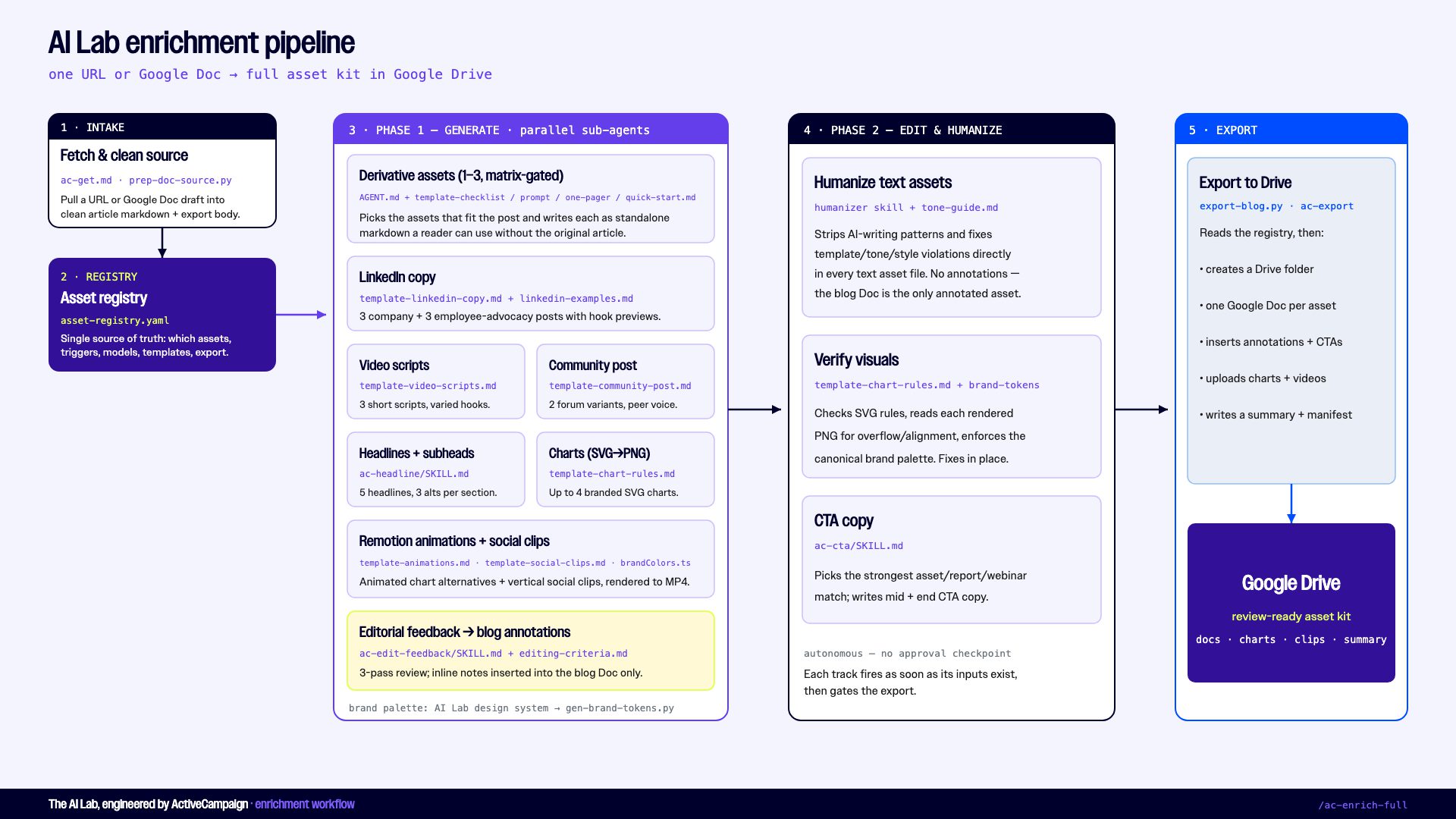
The content enrichment engine’s workflow.
What makes it work is the foundation he loads in first, the brand guardrails, and the running list of things he tells it never to do, long before he asks it to produce a single word.
More content (without sacrificing quality)
One AI Lab story goes in, 8–10 finished pieces come out, and Sean gets back roughly 15 hours a week he used to lose to production.
Neither Ryan, Will, nor Sean found a secret model or used a best practice prompt. They built a better foundation and did the boring work first. That’s the difference between slop and the work you’d be proud to put your name on.
Alright, let’s be real for a second, though. Most of us aren’t going to spend our weekends building badge scanners or content refreshers. You’ve got campaigns to ship, not a content operating system to architect. The good news is that context, the workflows, and the memory you need to build your AI foundations can come already built into the tool you choose.
This is the part where we tell you we built that
Where most AI tools hand you a blank page and ask you to describe your brand from scratch, Active Intelligence 2.8 starts from what you’ve already built.
The context is already there: 2.8 pulls from your Brand Kit, so the first draft wears your colors, fonts, and logos. It leans on your past templates and campaign history, so the structure looks like something your team would actually craft and send.
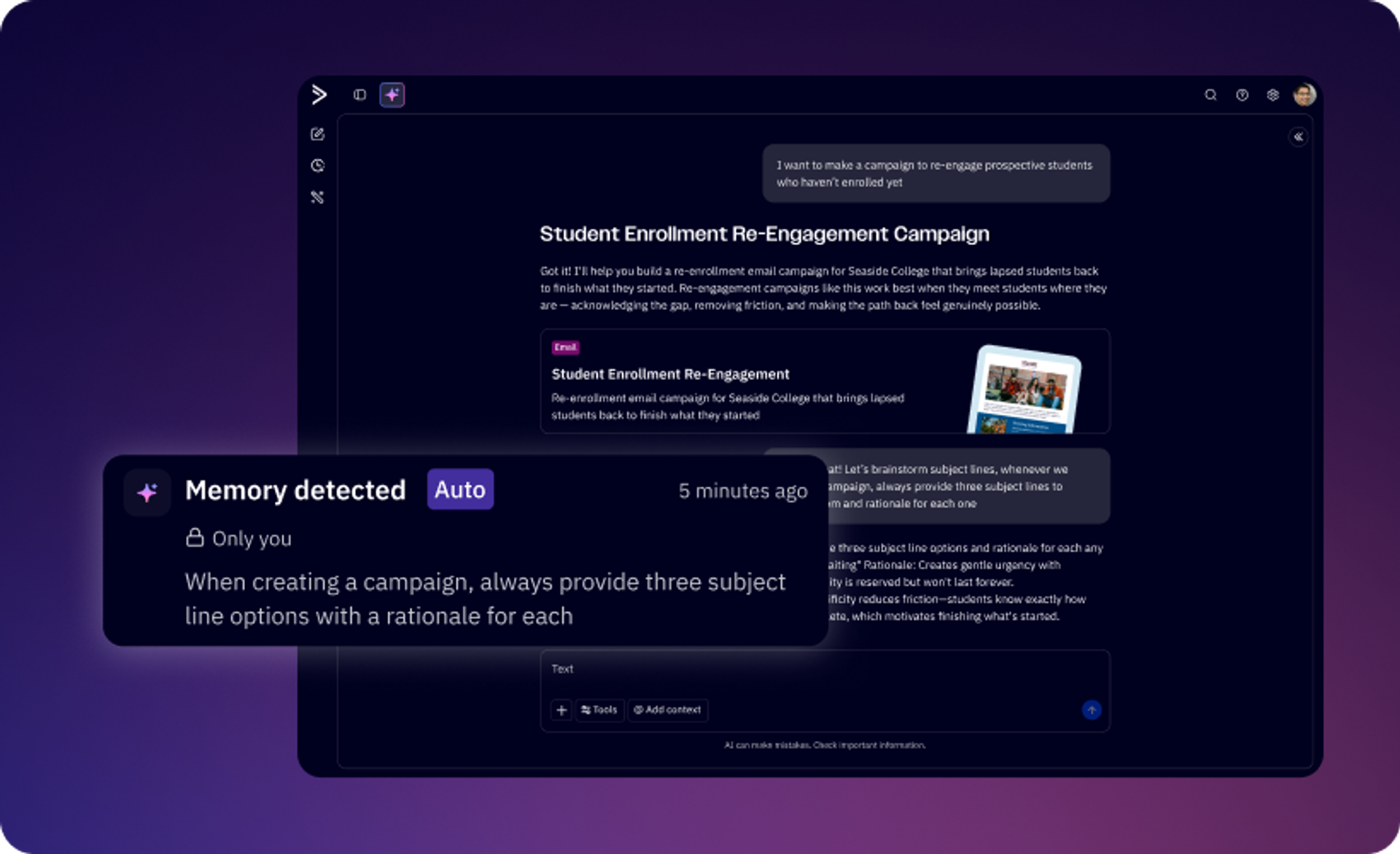
Because Active Intelligence can see across your entire account instead of one siloed chat window, it starts from what you’ve previously created instead of guessing. That’s the source-of-truth file Ryan built by hand, already in the tool.
Most AI tools will ask you to describe your brand from scratch. We did the opposite: Active Intelligence 2.8 already knows your brand and your past campaigns, so every draft comes from your best.
The workflow and memory come built in, too. Active Intelligence 2.8’s Campaign agent drafts a full campaign before handing you the wheel to lock in parts that are good to go, regenerate the rest, and edit in the designer to your heart’s content. It carries Memory and Custom Instructions across each session, so corrections you made last week are factored in tomorrow’s content. It gets more discerning each time you use it, much like the Ahrefs team’s content updater that learns what’s good and what’s slop.
What you get back is a starting point that already looks and sounds like you, not a generic draft that you need to tweak. And to be clear, Active Intelligence 2.8 isn’t the whole story. It’s proof of the shift taking over the autonomous marketing category, where systems are moving away from blank pages and building on the work you’ve already done.
Putting AI at the center of everything we build is a deliberate bet on where marketing is going. The next decade belongs to teams working alongside systems that understand their brand and carry real context, and Active Intelligence 2.8 is one concrete expression of that, giving marketers back the hours that used to disappear into setup.
So what do you actually do?
The time savings with AI are real; you can continue to enjoy that. It’s trust you need to earn, and you’ll earn it by changing how you use AI, not by waiting for a better AI tool to come along.
This means you need to hold every AI system you touch to three tests:
- Does it sound like your brand? If the answer’s no, then it’s not finished. It’s producing something that will inevitably turn into homework.
- Does it remember when a session ends? If you find yourself reintroducing your brand in each conversation, then it’s not autonomous.
- Does it build on what already works? If outputs are starting from scratch or are missing context from past works, it’s not the future. It’s just a faster way of making generic content.
Think back to that first draft that landed on your desk, or your digital desk (à la inbox). It looked promising but ultimately said nothing. It doesn’t have to be that way. A draft that wastes your entire afternoon and a draft you’d be proud to put your name on come from the same AI tools. The only thing that separates them is what the person did before they ever asked the AI to produce anything.
Related
More data from the AI Lab.

