How DigitalOcean updates its massive library of content 3-4x faster (without sacrificing quality)
At a certain scale, marketers have to be systems thinkers. They have to, brace yourself, think like developers.

It’s the start of the quarter, and your CMO just handed down a directive: keep thousands of pages of content fresh so each article has the most updated information and increased chances of appearing in LLMs and search.
Naturally, this seems like a perfect use case for AI, and it can be. However, the wrong workflows will create faster drafts, but not necessarily better ones. Massive content libraries are like codebases. And that’s when Anish Singh Walia, a technical writer at DigitalOcean, realized he had to tackle this problem like a developer.
DigitalOcean is an AI-native cloud infrastructure provider with a large educational content footprint, including more than 8,000 technical tutorials for developers. For DigitalOcean, these tutorials are part of a broader developer marketing strategy: they build trust, drive organic discovery, and introduce developers to the platform. They also have to be updated constantly as the technology they write about and the SEO/AEO rules are always changing.
There are parts of the updates that are specifically technical and require exhaustive testing with expert input. And there are parts of updates that are rote. This workflow handles the latter, so Anish can focus more on the former.
The result: the team can 3–4x the number of articles they update in a single day and far less back and forth between the editorial and SEO teams.
The problem with chat-based AI
Early on, Anish’s experience with AI writing tools looked like many marketers’. Drafts could be generated fast, but they were … generic.
“It was mostly a bunch of bullshit,” he says candidly. “I had to keep telling it not to sound robotic.”
Most content refresh workflows fail because AI is guessing at what you want. It doesn’t know the editorial rules, the SEO intent, your first-party research, or what has changed in reader behavior since the post was first published. Without real inputs, even the best models will poorly fill in the gaps.
So Anish made sure that the AI had all the context it needed to deliver an edit-ready first draft that:
- Loads editorial constraints, such as previous versions, a content brief, and style guidelines
- Pulls live search data via DataForSEO Model Context Protocol (MCP) servers
- Generates updates section by section, not all at once
He began using Cursor, an AI-first developer tool (also known as an integrated development environment or IDE), as the backbone of his content refresh workflow. Cursor’s strength lies in how it handles context. Instead of pasting prompts into a chat window, Anish works directly inside a workspace containing the files that define the project: the article draft, SEO brief, editorial guidelines, checklists, and supporting documentation.
That is a major shift from how most marketers use web-based AI tools like ChatGPT or Claude and is more in line with how developers use Claude Code or OpenAI’s Codex. In a typical chat interface, the model only sees the information pasted into the conversation. In workflows like this one, the AI can reference a broader working environment and pull from multiple connected files at once.
How mature is your approach to AI?
A typical marketer uses a chat interface in their web browser, while others are starting to move more towards workflows in tools like Claude Cowork. But the most advanced marketers, like Anish, work alongside AI agents inside a broader environment with more context.
See where your your AI maturity stands with this two-minute quiz.
“I ask it to strictly follow these documents while making updates,” Anish explains. This approach mirrors how software is built. The specifications come first, execution comes second, and cleanup is minimized because the rules for output expectations are clear from the start, thanks to the provided brand standards that Cursor uses as context.
Training data goes stale. SERPs change weekly. Here’s the fix.
Even with strong constraints, something was missing. AI still relied on the static knowledge of connected files and dated training data from the AI model used in Cursor. Using stale data would produce useless results. The turning point came when Anish connected Cursor to live search data through MCP servers.
Using DataForSEO, Cursor can pull real keyword statistics, search volume, and live search engine results page (SERP) data directly into the workspace. “DataForSEO basically gives you all the relevant search data,” Anish says. “Keyword stats, search volume, SERP data, everything.”
“You can actually see the actions running in the background,” he adds.
For example, you can verify that the MCP is pulling live search data when you see successful calls to the search volume API or organic live API, with details like location specified.
“The best part is, it’s not hallucinating,” he says. “Because it has the live data from the MCP server.”
Why Anish refuses to rewrite a whole tutorial at once
Getting the system running is mostly a one-time setup. Anish connected the DataForSEO MCP server inside Cursor by pasting in API tokens and account credentials, which allows the workspace to pull live data while he works.
The broad workflow is:
- Download Cursor and connect your tools and data sources
- Add context files to your project, such as editorial guidelines
- Load stale content and use the chat + your folder structure to co-write with your AI that has all of your context.
To start in Cursor, navigate to Settings → Tools → MCP.
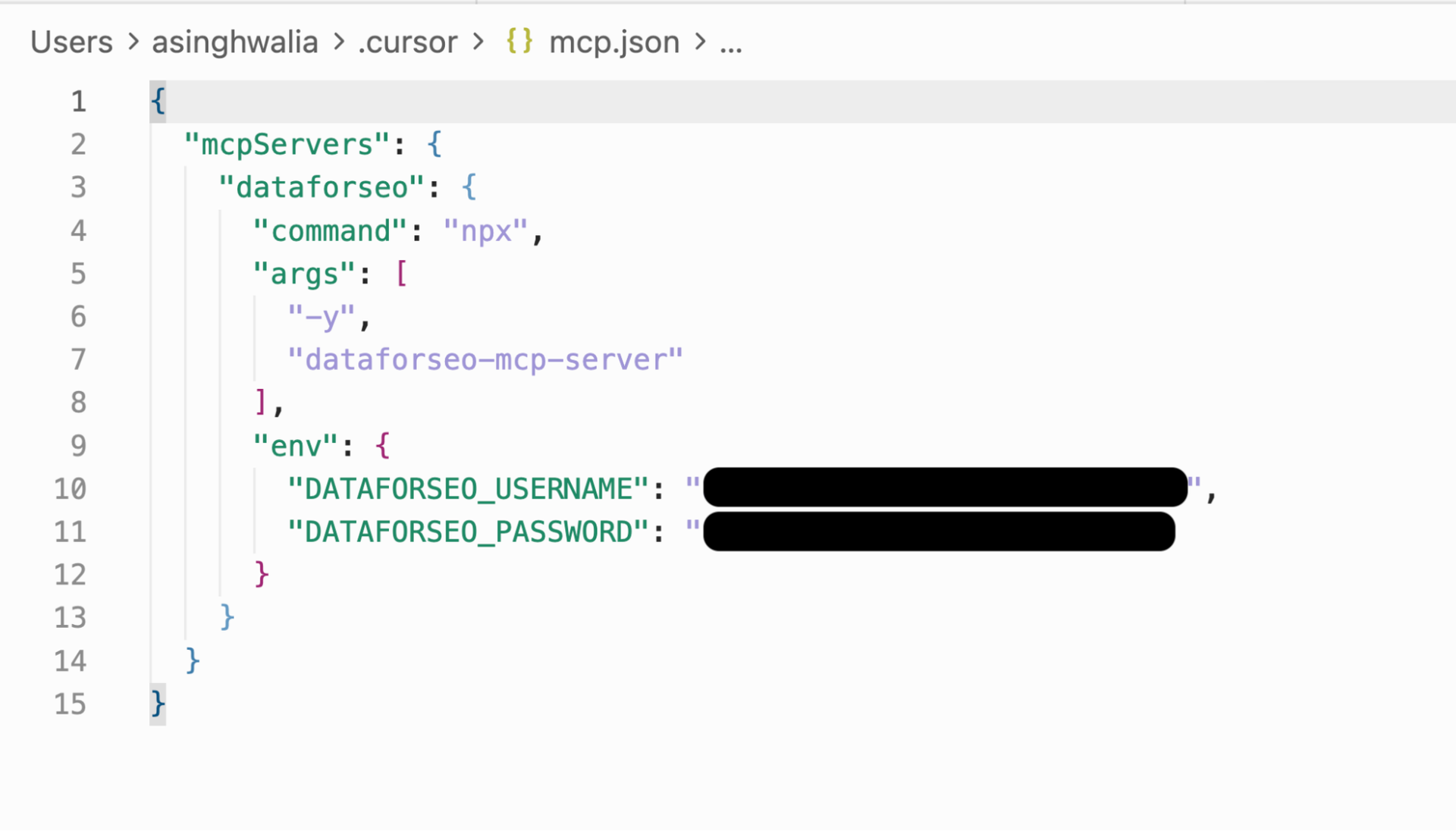
Entering in the API tokens for fresh data
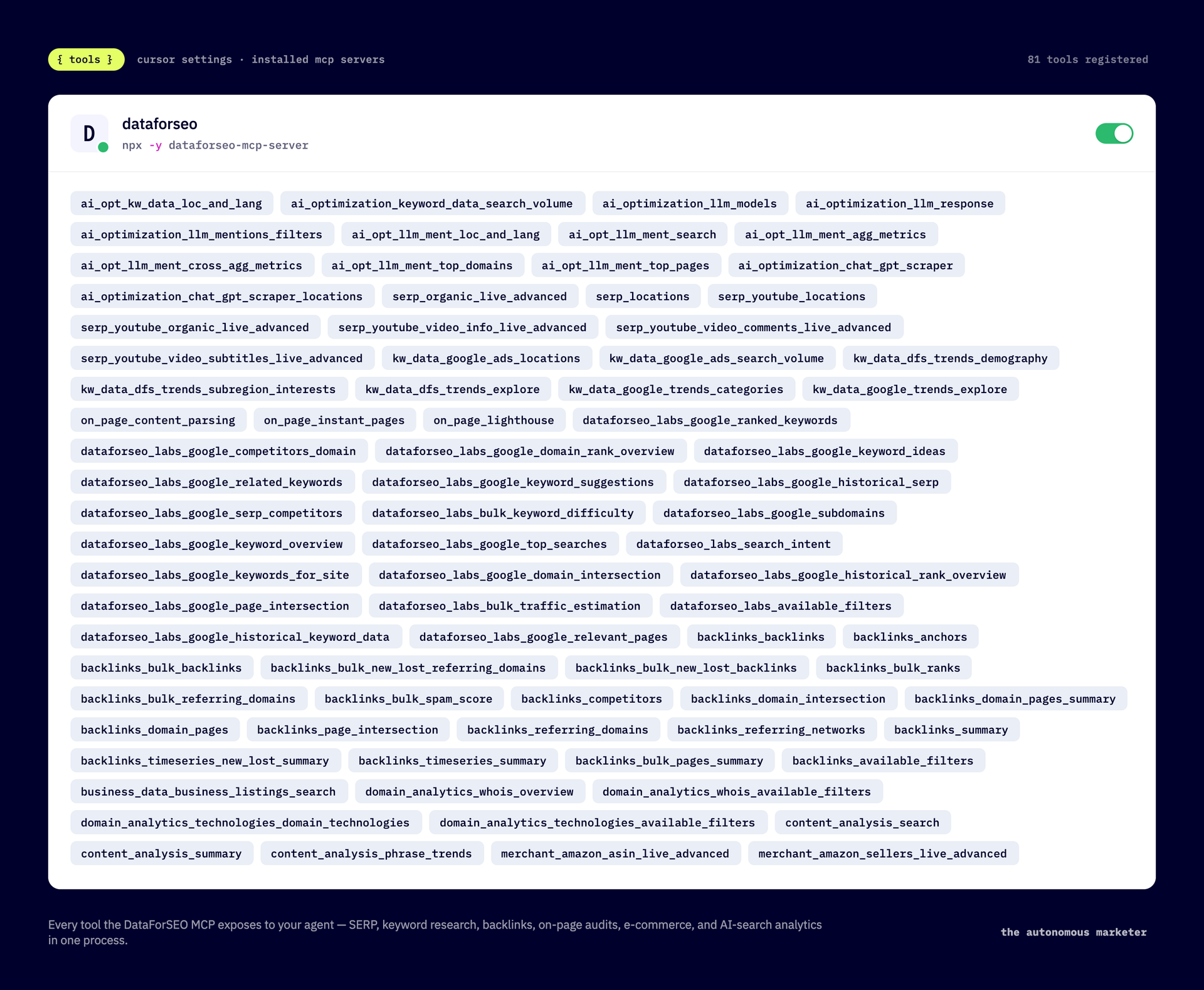
MCPs are powerful! Pictured: The capabilities for a DataForSEO MCP. Each item is another live data source to help Anish use the best data possible when refreshing.
Then, add MCP servers by copying/pasting API tokens and account details.
Anish recommends keeping it lean: mainly DigitalOcean MCP (for infrastructure tasks relating to his technical writing assignments) and DataForSEO MCP (for search data).
“You just need to copy and paste a bunch of API token stuff… very straightforward.”
After that, most of the work happens inside a single workspace.
Before Anish begins a refresh, he opens the existing article and layers in the surrounding context for the assignment, including brand standards, updated SEO guidance, and any relevant supporting materials.
Anish then references the brief file in his natural language instructions for Cursor, where he can “tag” documents (such as DigitalOcean’s SEO writer checklist and AI content writing guidelines) as if he were writing a social media post:
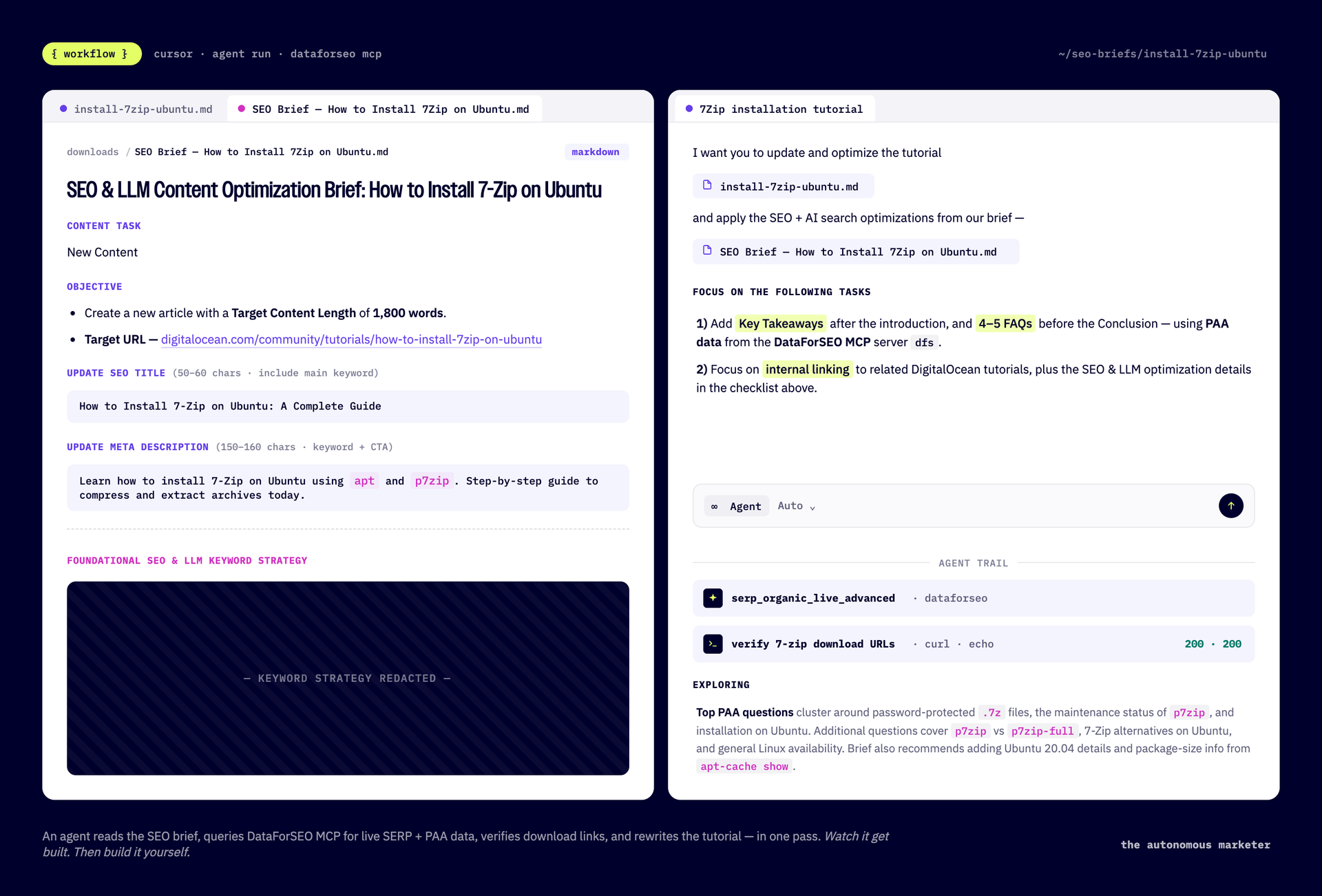
Writing in tandem with the AI.
He then prompts Cursor to pull live search data using the DataForSEO MCP server.
From there, Anish watches as Cursor runs actions to address the query in his prompt, in tandem with the instructions defined in his provided guidelines, which include:
- Keyword data + search volume calls
- Location targeting (often US, sometimes worldwide)
- SERP/organic results calls (“organic live… API”)
- AI optimization/keyword clustering-type calls (as supported)
Instead of refreshing an entire article at once, he goes one section at a time. Meta titles, meta descriptions, and the opening paragraph are usually the starting point. “Give me an updated title and description based on the SEO brief,” he’ll prompt, “and make sure you use actual search data.” Cursor can even apply those changes directly to the file when needed.
Here’s what this prompt looks like:
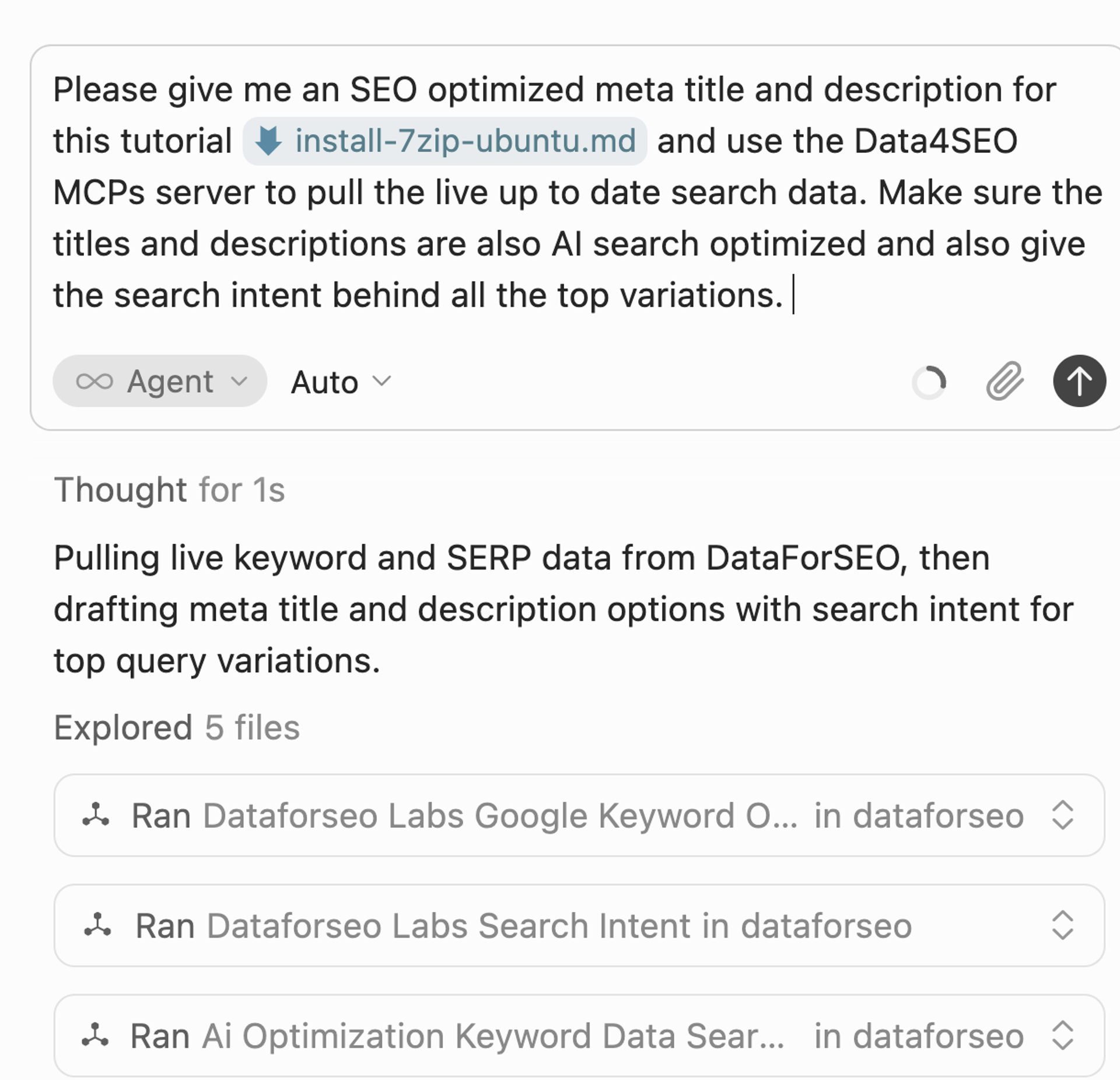
Calling the MCP for the finishing touches.
And the output:
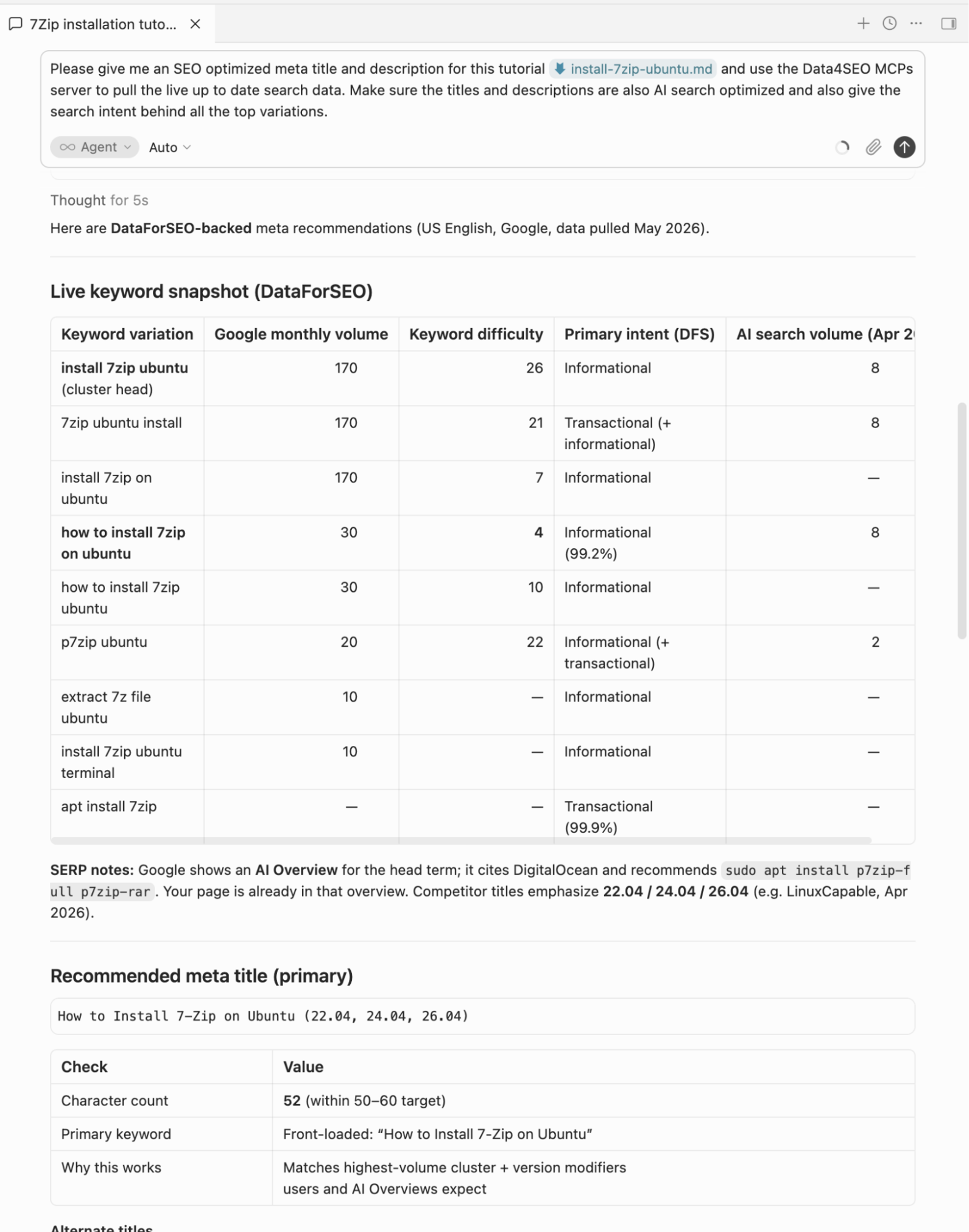
After that, Anish works sequentially, prompting Cursor to update each one. “If you ask it to generate the whole tutorial, it usually generates a low-quality first draft, and most of it is AI slop,” he says. “I do it step by step.”
His update sequence typically looks like:
- Intro (SEO-aligned hook)
- Supporting sections (as needed based on brief + gaps)
- FAQ ideas (if relevant)
- Cleanup/refinement editing pass
He can review and calibrate as he goes, rather than untangling a bad update of an entire article all at once. Then, with the AI updates in place, he invites subject matter experts to focus on the tutorial and technical aspects.
De-slopifying with thoughtful updates to the system
Even with the provided context, early updates would miss the mark, and the workflow required constant calibration:
- When outputs sounded robotic, he tightened tone and style constraints.
- When sections lacked depth or drifted from search intent, he added more structured briefing documents and live SERP data.
- When the AI generated overly broad rewrites, he narrowed the scope to section-by-section updates instead of full-article generation.
Over time, Anish built a small set of reusable prompts that support this workflow. “I ended up with around nine prompts after a lot of testing,” he says. Some are used on nearly every refresh, including prompts for generating FAQ sections and identifying related topic clusters.
To surface real user questions, Anish also pairs Cursor with SEO tools like AlsoAsked and Answer the Public. The outputs become headings or FAQs that reflect how people actually search, not just how tools suggest expanding content.
And no matter how refined the system becomes, every piece of content passes through human review.
“AI is a great tool, but it still needs an expert operator,” Anish says. “It needs somebody to steer the ship.”
From days to hours: 3–4x more content updates
Anish now spends less time rewriting generic AI output and more time refining high-value sections that require technical judgment.
Before using this workflow, Anish and his team would spend a half day on a single review, followed by a full SEO review cycle. The end-to-end process often took close to a full working day per content piece. With this workflow on the Cursor and DataForSEO MCP server, the turnaround time has been reduced to a few hours, cutting total production time by nearly 60–70%.
The team can now update 4–5 content pieces daily, up from 1–2 previously, resulting in a 3–4x increase in content throughput. Other writers and even solutions architects at DigitalOcean have picked up the same workflow.
At the same time, drafts are better aligned with SEO and AI search requirements from the start, leading to fewer revision cycles and an estimated 50–60% reduction in back-and-forth between editorial and SEO teams.
Editorial review cycles become shorter because drafts are closer to publish-ready from the start. His team can now maintain massive tutorial libraries without sacrificing the bandwidth needed to create new content.
“Humans will always need human validation,” he says. “Unless you enhance your skills using AI—you won’t be easily replaced.”
Resources to replicate these workflows.
More data from the AI Lab.
