You don’t have an AI problem. You have a “Dead Knowledge” problem
How to tighten the turnaround time of proposals by 10x with the right knowledge system.

If you handed Bryan Cassady your company for a day and said, “Build us a knowledge system from scratch,” he wouldn’t start with your documents.
He’d go find the break room.
“That’s where people talk,” he says. “You learn the stories of the organization. The real ones.”
Cassady is an innovation professor, keynote speaker, and author of The Generative Organization AI Playbook. He has built Living Knowledge systems for clients across three continents. And often, when complex organizations struggle to derive value from AI, it’s because of the inputs they use.
The right knowledge systems reduce back-and-forth and give team members a head start. When a team pulls from the same context, it can move more quickly. Before, that was the stuff that died in intranets and internal wikis. It was “Dead Knowledge.” And most AI projects fall because they are built on outdated info.
“Most organizations don’t have an AI problem,” he says. “They have a Dead Knowledge problem.”
| The difference |
| “Dead Knowledge” is knowledge that exists in one place but is needed somewhere else. Training that happened and then got buried. Research that lives in a folder nobody opens. It’s a frustration for marketers who can’t access what they know when they need it. |
| “Living Knowledge” is constantly updated and accessible to all the stakeholders who need it. Before AI it required onerous processes and tooling. But with AI, you can leave the heavy lifting to the agents. And in this story, we’ll share how Cassady builds such systems for his clients. |
Cassady and his marketing clients use Living Knowledge systems to:
- Reduce the number of revisions in campaign proposals (one team reduced average proposal edits from 30 to 3).
- Identify instances in new proposals where the same recommendation was made a few years earlier, and the CEO flatly rejected it.
- Upload dozens (or hundreds) of marketing campaigns from multiple competitors and use NotebookLM to surface angles no competitor is using.
- Create a “voice guide” pulled from the CEO’s speeches and social posts for use in writing proposals and more.
When a company embraces Living Knowledge, institutional memory survives turnover. Once implemented, teams stop wasting time rediscovering what they already paid to learn.
Here’s how it works:
- Interview the team
- Create a True N.O.R.T.H. one-pager to guide the AI
- Build the two-tier library
- Connect the library to AI
- Generate proposals and ideas
Step 1: Interview your people before you touch your documents
Cassady starts with a series of open-ended questions sent to a mix of senior executives and front-line staff.
The core is always the same: What does this company do? What’s your value proposition? What problem do you actually solve? What are you not doing?
Cassady’s interview method is designed to bridge the “alignment gap” that exists in almost every organization. According to Cassady, the primary reason for these specific questions is to ensure that the Living Knowledge system is built on the company’s actual operational reality rather than its “official” story.
Research on strategy execution repeatedly shows that many executives cannot accurately name their company’s top priorities. Cassady says he sees the same misalignment every time he interviews leadership teams.
He calls this the Type 3 Error: solving the wrong problem right. The interview exists to ensure the system is built on what the organization actually does, not on the story it tells itself.
Then he has AI read every response and identify two things: what people agree on, and what they don’t.
Senior leadership usually thinks the strategy is crystal clear. And the people closest to the customer are telling a completely different story. The gap between those two things is where every positioning problem lives.
With a good survey tool and a NotebookLM notebook set up to analyze responses, you can have a full organizational alignment report in under two hours.
If you skip this step and upload your existing content first, you’ve seeded the system with the official story, which may bear no resemblance to how your customers, your sales team, or your front-line staff actually understand what you do.
Remember this
A system built on misaligned input gives back misaligned output, just faster.
After uploading interview transcripts to NotebookLM, he queries with:
What do respondents agree on about what this organization does and who it serves?
Where do responses contradict each other? Identify the three sharpest disagreements.
What phrases do people use to describe our value that we are not using in our official messaging?
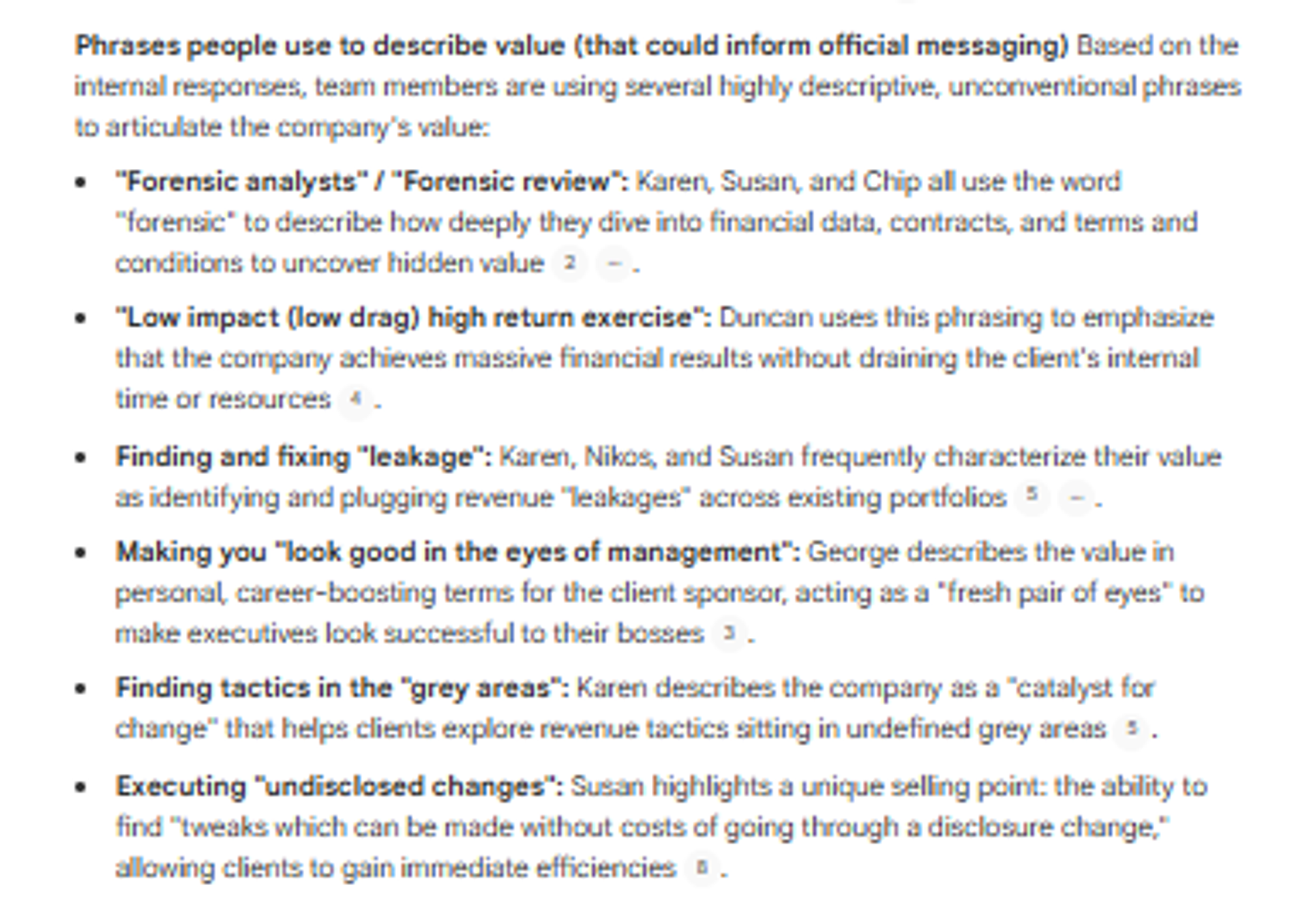
A NotebookLM output for the above prompt. Notice how the AI can pattern match across multiple sources.
Step 2: Define your True N.O.R.T.H. before you propose anything
Once he has a clear picture of the alignment gaps, Cassady builds what he calls a True N.O.R.T.H., a one-page strategic anchor. The name is an acronym.
Cassady has run innovation sprints with dozens of companies. He says ideas from sprints that start with a True N.O.R.T.H. are three to four times more likely to be accepted by management, because they address the company’s objectives rather than being merely creative.
True (Truly simple/one-line summary): This is a single, memorable headline or statement that distills your entire mission into its core essence. Cassady describes it as your “innovation mantra” that people should remember even if they forget everything else.
The N.O.R.T.H. acronym then breaks down the specific details of that mission:
- N — Narrative (Tell the story): Explaining the bigger story of why the challenge is important, creating meaning and context so the team understands the motivation.
- O — Objective / Outcome (Results you want): Getting highly specific about what success looks like, essentially finishing the sentence: “We need ideas for _____”.
- R — Restrictions (Understand what’s out): Explicitly stating what you are not doing (e.g., avoiding certain markets, resources, or technologies) so the team can focus their creative energy.
- T — Tactical Constraints (Establish operating limits): Defining the non-negotiable boundaries, such as time limitations, budget, design, or regulatory requirements.
- H — Here is the place to start (Navigate starting points): Giving the team concrete areas or relevant live projects to begin looking for ideas, which helps defeat analysis paralysis and creates immediate momentum.
“Before you drown in the data,” he says, “make sure you know the questions you want to ask the data.”
Cassady ran an innovation sprint with a large advertising agency working on taglines for a premium knife brand. Before introducing True N.O.R.T.H., the team’s ideas were generic.
The True N.O.R.T.H. exercise resulted in them anchoring the brief to the brand’s heritage, craftsmanship, and the specific customer who buys a $400 knife as a statement about who they are. Much more specific and true to what they actually believed, versus the generic “Dead Knowledge” messaging documents.
Use this
I would like your help writing a True N.O.R.T.H. for this challenge: [describe your project or campaign objective]. Ask me questions to build this step by step.
The GPT walks you through each letter. The output is a one-page document that you can upload as the first source in your knowledge system.
Think through the following before opening the GPT:
1. The narrative (the strategic context)
- The goal: Give the AI a “reason to care.”
- The action: Don’t just say “Write a blog post.” Explain the market tension. What is the current “villain” or “mess” your audience is dealing with? (e.g., “The industry is flooded with generic AI content, and our audience is tuning it out.”)
2. The objective (the “single sentence” test)
- The goal: Define a binary win state.
- The action: Complete this phrase: “We need ideas for [X] that will result in [Y].” If you can’t fit it into one sentence, the AI will hallucinate a priority that isn’t yours.
3. Restrictions (the boundary walls)
- The goal: Prevent “creative drift.”
- The action: Explicitly tell the LLM what is off-limits. List the topics, tones, or competitor styles you want to avoid. This is the most underrated step in prompting; telling an AI what not to do is as important as telling it what to do.
4. Tactical constraints (the guardrails)
- The goal: Ground the AI in reality.
- The action: Define the hard limits: word counts, specific formatting (tables vs. prose), reading level (e.g., “Write for a busy CFO, not a student”), and required calls to action.
5. The starting place (the seed knowledge)
- The goal: Provide the “moat.”
- The action: Instead of asking the AI to “invent” ideas, give it a specific starting point. “Start with the transcripts from our last three client interviews” or “Use the core logic from our 90-day execution plan.” This keeps the output grounded in your unique data.
6. Truly simple (the North Star headline)
- The goal: Ensure the “vibe” is correct.
- The action: Create a “Title” for the mission. This acts as a permanent anchor in the LLM’s context window. If the output doesn’t match the headline’s promise, you know you need to refine the prompt.
Step 3: Build the library (and keep the AI slop out)
With alignment data and a True N.O.R.T.H. in hand, Cassady builds the actual Living Knowledge system. He runs NotebookLM as two separate notebooks.
Notebook 1: The standing library. A permanent notebook seeded with everything the organization knows: past campaign briefs, customer interview transcripts, frameworks the team actually uses, winning proposals, and post-project lessons. This is the always-on brain. Upload entire folders, not individual files. NotebookLM can handle 1,000+ page documents without breaking.
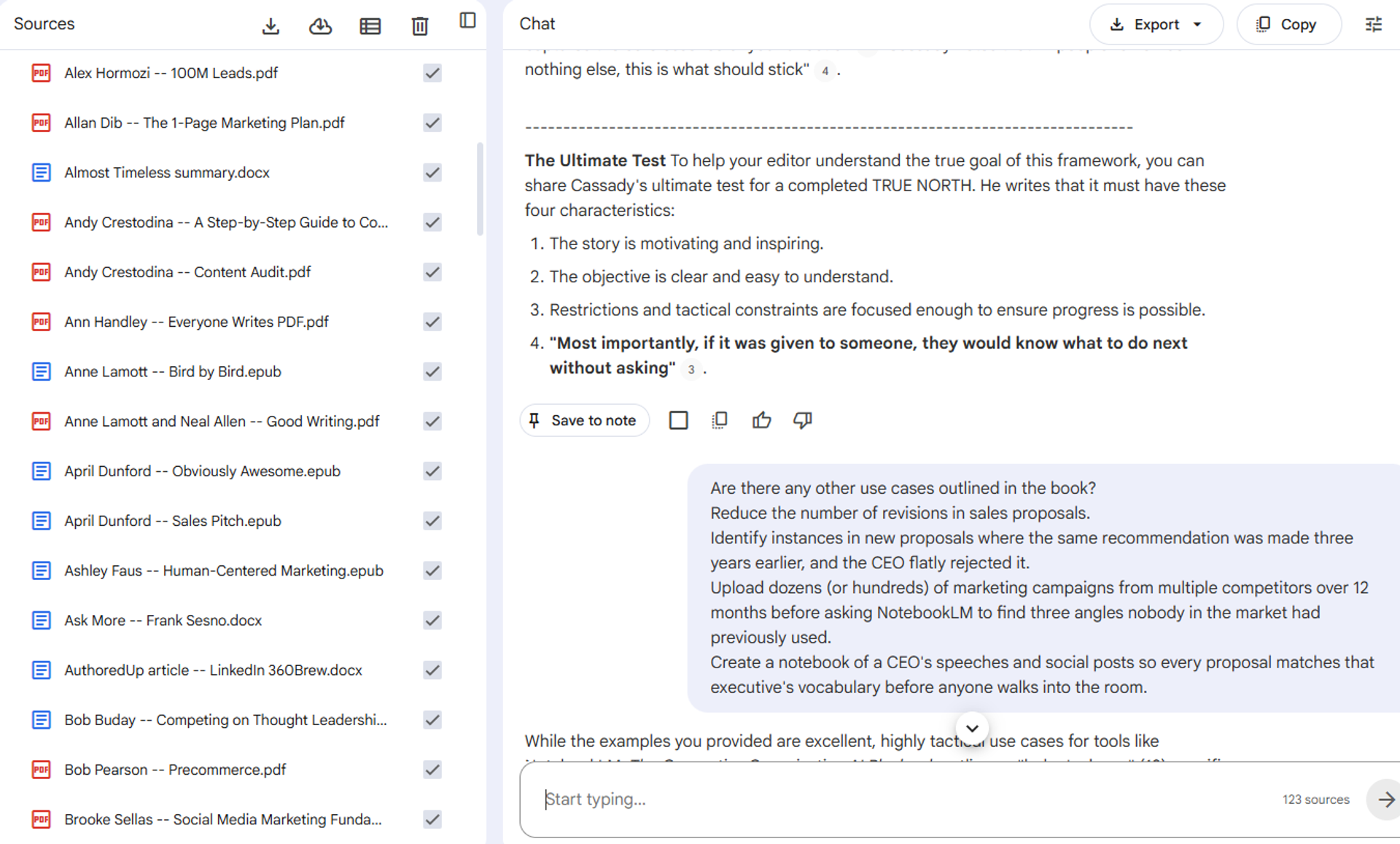
Notebook 2: The live-challenge notebook. For each new campaign or project, spin up a second notebook that reuses the canonical sources from the standing library but adds project-specific files: the brief, the client objectives, and relevant competitive research. This keeps the standing library clean and the project notebook focused.
One critical warning: Be selective about what goes into the standing library. Cassady is direct on this point.
Nine out of 10 LinkedIn posts from founders right now are written by AI. If you upload all of that, you’ve infected your system with something that sounds nothing like the actual human you’re trying to build around.
Scraped content, AI-generated posts, and polished PR copy all carry the same problem: They’re sanitized and have gone through multiple revisions or filters, and authentic voices are often lost. The interview transcripts from Step 1 are more valuable than any amount of published content.
What to upload (and what to leave out):
Upload:
- Customer interview transcripts, verbatim
- Proposals that won (and a few that lost, with notes on why)
- Internal frameworks the team actually uses
- Post-campaign retrospectives
- Interview transcripts from your people survey (Step 1)
Leave out:
- LinkedIn posts (assume AI-generated until proven otherwise)
- Press releases and approved messaging documents
- Anything that was written to sound good rather than be accurate
Step 4: Point Gemini at everything your company knows
NotebookLM is where the knowledge lives. Gemini is where the synthesis happens. Connecting them takes about 30 seconds.
Open Gemini. Click the small plus sign in the lower left corner. Select your NotebookLM notebook as a connected source. From that point forward, every Gemini prompt has access to everything in the notebook, representing the organization’s actual knowledge, not the generic training data every competitor is using too.
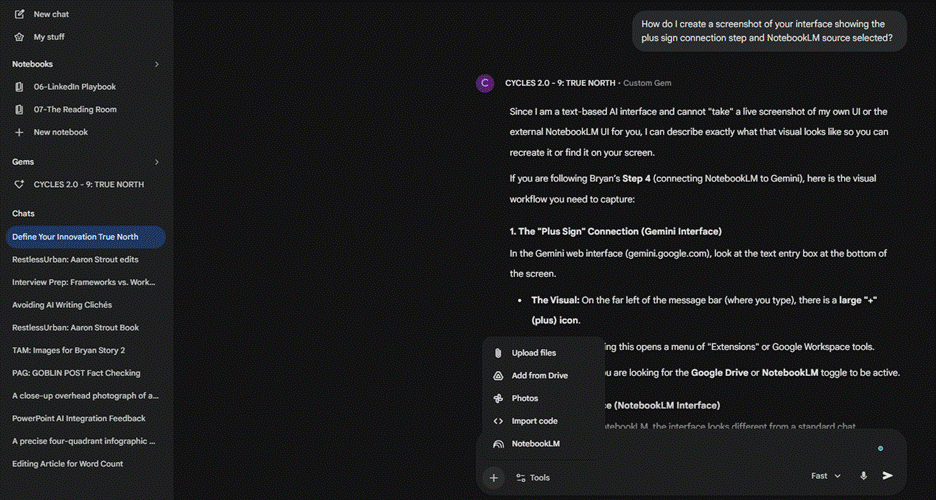
Cassady uses this combination for competitive intelligence. Upload your competitors’ campaigns into a NotebookLM notebook. Connect it to Gemini. Then, send this prompt:
Use this
I’ve uploaded [number] competitor campaigns into this notebook. Based strictly on what’s there, identify the three angles nobody is using. For each one, explain why it’s absent and whether that absence is a gap or a deliberate choice.
“A static folder of saved links becomes a competitive intelligence system in an afternoon,” he says.
Another use case: Cassady often delivers keynotes on his Living Knowledge system in industries he doesn’t know well. So he uploads five books by domain experts alongside his own presentation, then queries the combined source: “From these five authors, give me a review of my speech. What have I missed? What assumptions am I making that an expert would challenge?” He calls it paying five consultants for a day.
Step 5: Generate in bulk, then let the system evaluate
Once the library is built and the objective is clear, Cassady generates hundreds of variations against the defined True N.O.R.T.H. in about 15 minutes.
In the knife example from Step 2, the goal wasn’t to use every idea. It was to have enough options that the right answer became obvious rather than chosen by default.
The knowledge system becomes the first reviewer, checking proposals against the client’s known preferences, validating campaign concepts against past performance data, and flagging contradictions between what customers said in interviews and what the draft assumes.
In another case, Cassady built a Living Knowledge system for a major marketing agency:
Junior team members were spending most of their time reading through documents and very little time actually thinking. After the system went in, junior team members presented stronger proposals to senior partners.
The system caught something human memory couldn’t: proposals the client’s CEO had already rejected two years earlier. Junior team members, new to the account, had no way of knowing. The knowledge existed inside the agency, but no one could access it when it mattered.
| Before: A major proposal went through 30 reworks. Senior partners spent most of their review time correcting foundational issues. |
| After: The same type of proposal required two or three revision cycles. The system had already caught the foundational issues before the proposal reached a senior reviewer. |
One junior team member went further. She uploaded recordings of the client CEO’s speeches, interviews, internal presentations, and social media posts so that every proposal could match that executive’s vocabulary and communication style before anyone walked in the room.
“The system didn’t replace their judgment,” Cassady says. “It made their judgment sharper and faster.”
The evaluation prompt Cassady uses before any deliverable goes out:
Before I share this with the client, evaluate it against everything you know about their preferences, their past feedback, and their stated objectives. What are the three weakest points? What contradicts something they’ve told us? What would make them push back immediately?
Three things change when knowledge becomes queryable
- Decisions get made on complete information. Not on whoever had time to dig, not on what someone remembered from a campaign two years ago. The full picture is available.
- Institutional memory survives turnover. When a senior account executive leaves, her knowledge about the client used to leave with her: the quirks, the approaches that worked, the ones that didn’t. A Living Knowledge system means what she knew stays queryable.
- The team stops rediscovering what it already knows. Every hour spent re-reading a past brief, rebuilding a lost framework, or relearning a lesson from an undocumented failure is the compounding cost of Dead Knowledge. Living Knowledge makes that hour productive instead.
Building a Living Knowledge system requires deciding what goes in, how it’s organized, and what questions it should be able to answer six months from now. That decision doesn’t happen automatically. The five steps above take a day. The ongoing work includes keeping the system current, adding new interview transcripts, incorporating campaign retrospectives, and pruning content that no longer reflects the organization.
“Get the question right before you look for the answer,” Cassady says.
Resources to replicate these workflows
More data from the AI Lab.