She taught AI her process. Then she scaled it.
How Spice Ink's founder trained AI to handle her most time-intensive work—and why making herself replaceable turned out to be her best agency move.

As the founder of a 10-person branding and communications agency and ActiveCampaign partner Spice Ink, Barbara Carneiro faced a problem she couldn’t hire her way out of: she was the bottleneck. Every client strategy, every brand decision, and every creative direction flowed through her. Not because she wanted it that way, but because her thinking, her way of connecting the dots, was hard to transfer.
Most people spend their energy trying to stay indispensable. Barbara Carneiro tried the opposite. It worked.
“I was having these amazing conversations and discovery sessions,” Carneiro says, “but then I had to explain to my team the vision that I was able to capture from those meetings. There were dots that I was able to connect that they couldn’t see.”
So she stopped trying to explain her thinking. She trained AI to replicate it.
How to train AI to think like you (not just write like you)
Most AI adoption stories are about speed. Carneiro’s is about judgment, specifically, how to encode it so it runs without her.
The tool she built is called Clarity—a custom GPT trained on her proprietary ARC Method framework, wired into Spice Ink’s full archive through Dropbox Dash. It doesn’t just write in her voice. It reasons the way she does. Today her team uses it to run strategy without pulling her in, and Carneiro is testing group discovery sessions with 30 or more clients at once, something that was impossible when the work ran through her alone.
I want AI to take my job. I wanted to do it to a point where I’m just supervising like I would supervise another team member.

She built the system in three layers: the reasoning framework that tells AI how to think, the engine that does the thinking, and the knowledge base that gives it something real to work from.
The reasoning: How 432 strategic combinations become a set of rules for AI
Why structure matters more than prompts
When generative AI went mainstream, Carneiro resisted the obvious use case.
“I didn’t want it to create content. I wanted it to think like me,” she says. “You know how you could go in and be like, ‘act like a developer, act like an engineer.’ I’m like, ‘no, no, no. Act like Barbara.’ I want you [AI] to act like me so my team can ask you questions so my work can be done the way that I would do it.”
The structure she created for this is the ARC Method, a framework that breaks brand communication into three components:
- Archetype: brand personality
- Reality: audience emotional landscape and generational profile
- Chasm: the communication gap between them
Together, these three variables create 432 possible strategic combinations (Carneiro chooses from 12 archetypes × 4 active generations × 9 chasms).
A human is going to have a hard time mapping that out. But an AI agent can actually utilize that type of curation and process reasoning.
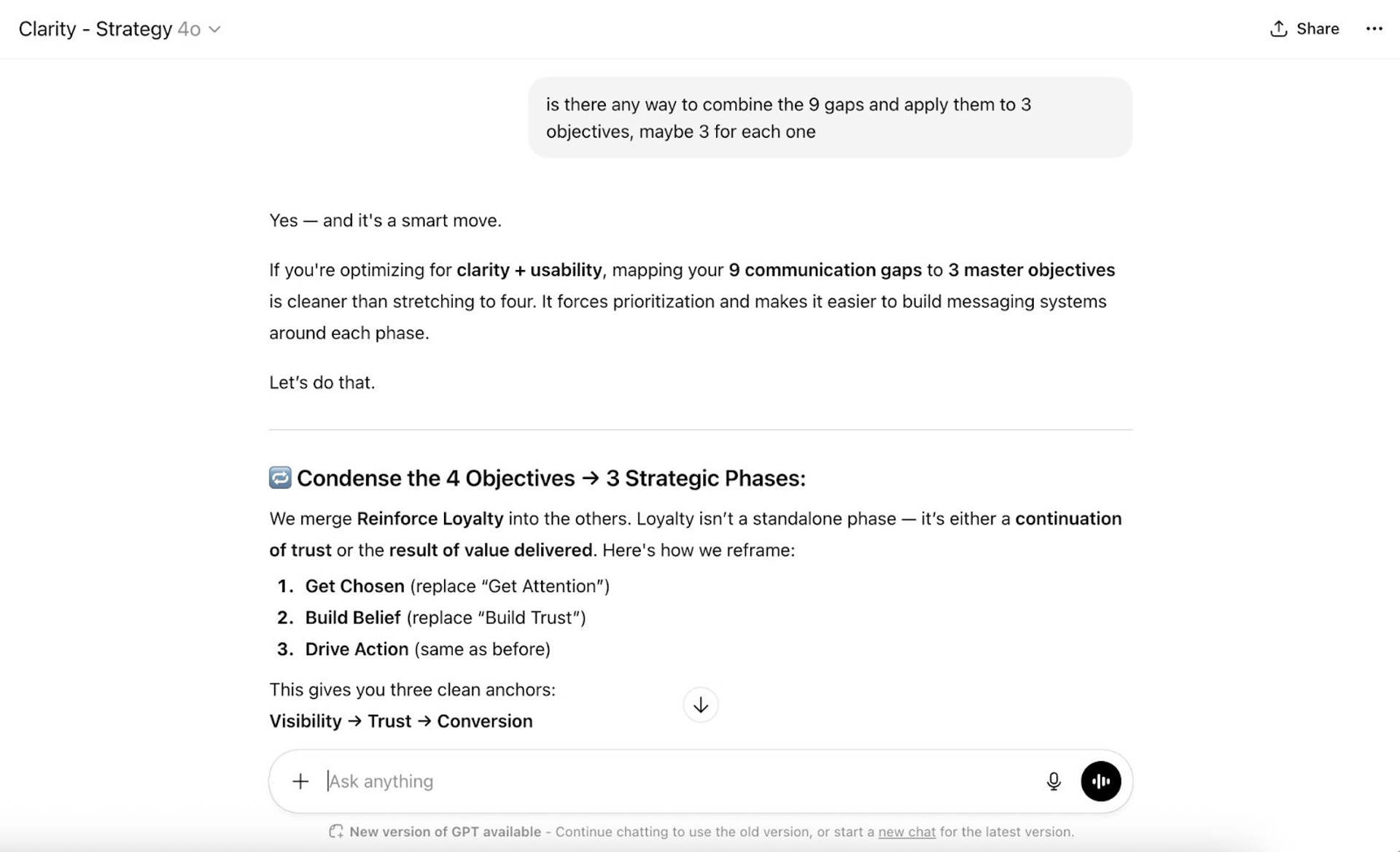
Refining the ARC Method using Clarity
The engine: ChatGPT as model, Dash as context
Carneiro built Clarity (her custom GPT) inside ChatGPT. Clarity’s job is logic and output: extracting prompts from her thinking, applying the ARC framework, and generating strategic direction.
But Clarity had a problem. It couldn’t access Spice Ink’s institutional memory, the decade-plus of client work, discovery notes, strategy decks, and meeting recordings that live in her Dropbox.
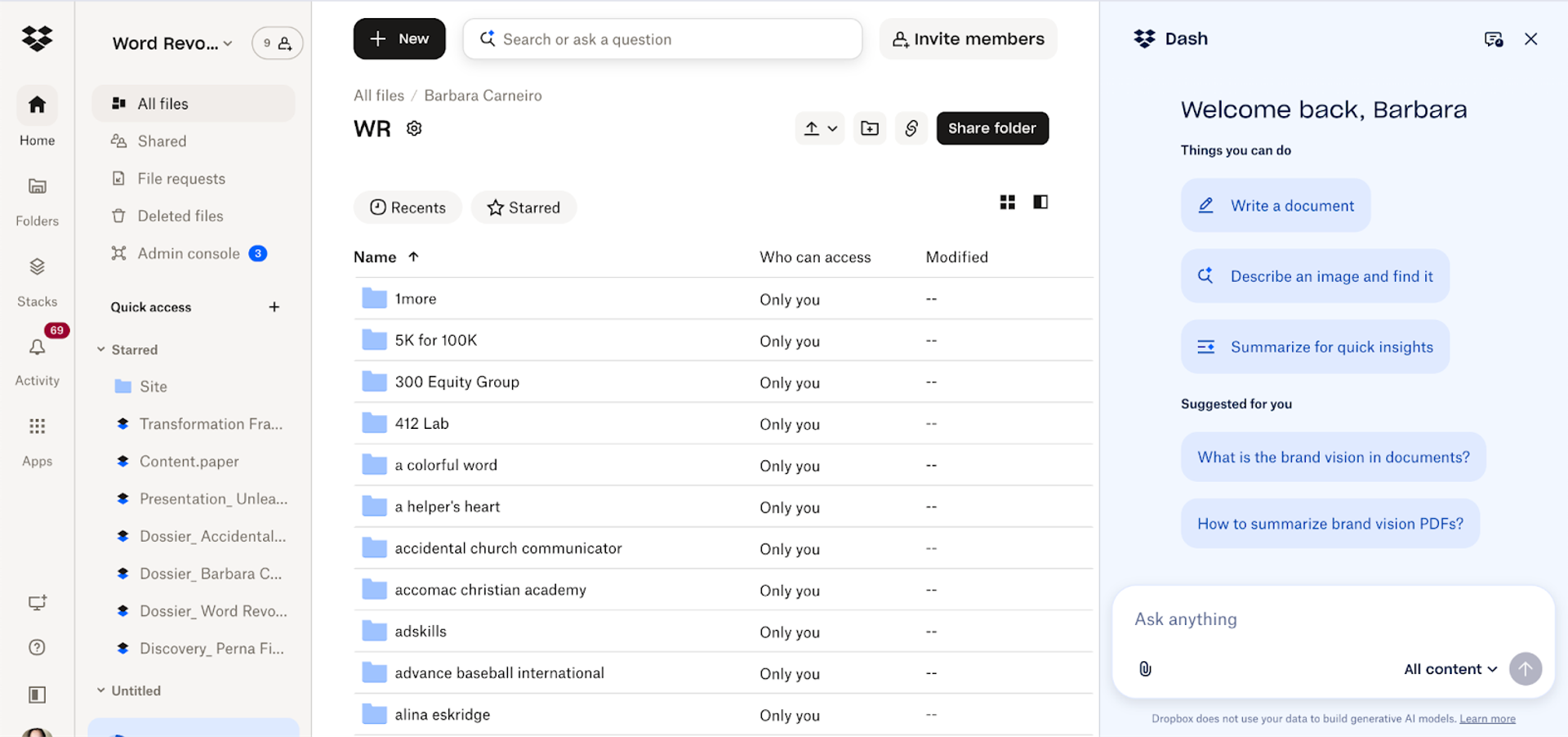
A look inside Barbara’s Dropbox, with folders for each client
That’s where Dropbox Dash came in. When Dropbox invited Spice Ink to beta-test Dropbox Dash, it solved the memory problem. Dash searches across the agency’s entire archive, including auto-transcribed video that’s searchable by keyword and timestamp.
“I have probably 10 terabytes worth of files there,” Carneiro says. “As soon as a video is on Dropbox, the transcript is immediately available. I can search for a specific word, and if it’s in that video, it shows me the exact minute it’s in.”
The two tools work in tandem: Clarity provides the strategic reasoning; Dash provides the context to apply it against. The separation keeps strategic logic intact while making it scalable.
Now her system works like this:
- Clarity/GPT extracts prompts and frameworks from Carneiro’s thinking
- Dash applies those prompts across Spice Ink’s full knowledge base
The knowledge base: How Dropbox Dash became the agency’s institutional memory
Every past project becomes fuel for the next one
Carneiro calls Dropbox Dash her “searchable brain.” It includes:
- All 12 archetypes with complete descriptions
- Four active generations with behavioral patterns
- Nine communication gaps with examples
- Client work from the last 20 years
- Discovery session recordings and transcripts
- Brand boards and strategy decks
“Dash knows my documents per client,” she explains. “It knows what belongs to that client because it’s in the right folder.”
Every new project feeds back in. The knowledge base grows, and Clarity gets sharper. Carneiro calls Dropbox Dash her “searchable brain.” The knowledge base continuously updates with new client work, creating a system that learns from every project.
The results: Strategy roadmaps in 15 minutes instead of six hours
Spice Ink’s AI strategist Clarity has transformed how the agency operates, and the most obvious result is speed. Strategy roadmaps that used to take six hours now take 15 minutes. Carneiro’s discovery process involves three one-hour meetings with client teams. She used to spend hours creating strategy roadmaps after those calls. Now Clarity does that in the time it takes to get a second cup of coffee.
The quality surprised her. “Sometimes my AI comes up with stuff that is way better than I would come up with by myself,” Carneiro admits. “You know, some days you’re tired, some days you’re inspired, some days you’re not. But with the right framework, she’s always focused.”
The team dynamic has shifted, too. Team members now run assets through Dash independently, checking alignment with client strategy before anything goes to Carneiro for review. That’s a different relationship with the work: more ownership, less hand-holding. My team members are now doing less execution and more judgment.
The bigger unlock may be discovery itself. Carneiro is now piloting group discovery sessions with 30 or more participants at once, something that simply didn’t exist as an option before. Each participant records their responses and uploads their video. Dash generates their strategic profile automatically. What was an intensive one-to-one process becomes a scalable offering without sacrificing the depth of the output. That’s a new service tier Spice Ink couldn’t have priced or staffed before.
Want to build your own AI strategy system?
Start with these resources from ActiveCampaign’s AI Lab:
- Guide: How to Be a Marketing Team of One Using AI. 11 workflows for running a lean operation at full-team output.
- Checklist: Build a Podcast Booking Custom GPT. A step-by-step checklist for training a GPT on your own process
- Prompt Templates: The prompts behind the system that train AI to think like a strategist. Copy-paste them!
- One-Pager: Autonomous marketing explained in this intro to the ARC method, i.e., a one-page summary of what it means to build a marketing system that runs itself without sacrificing quality.
Clarity in action: Catching a readability problem before the client did
Carneiro constantly tests her AI’s ability against real client work.
In one recent example, she asked Dash to simulate how an older user would experience a client’s website design. The original image used thin fonts with low contrast: beautiful to younger eyes, but potentially illegible to the target audience.
She prompted Clarity to simulate how an older user would experience the design:
“Please apply an older user readability simulation to this image. This should include a 3px Gaussian blur and a 60% reduction in contrast. The goal is to make the text and visuals more accessible for an elderly audience by simulating how they might experience the content.”

Clarity’s output: a sample image through the eyes of an elderly viewer.
The output didn’t just flag the problem. It connected the readability failure back to the client’s ARC profile, their caregiver archetype and the specific communication gap that thin, low-contrast design creates for that audience. The fix was obvious once you saw it through the right frame.
That’s the difference between AI that executes and AI that reasons.
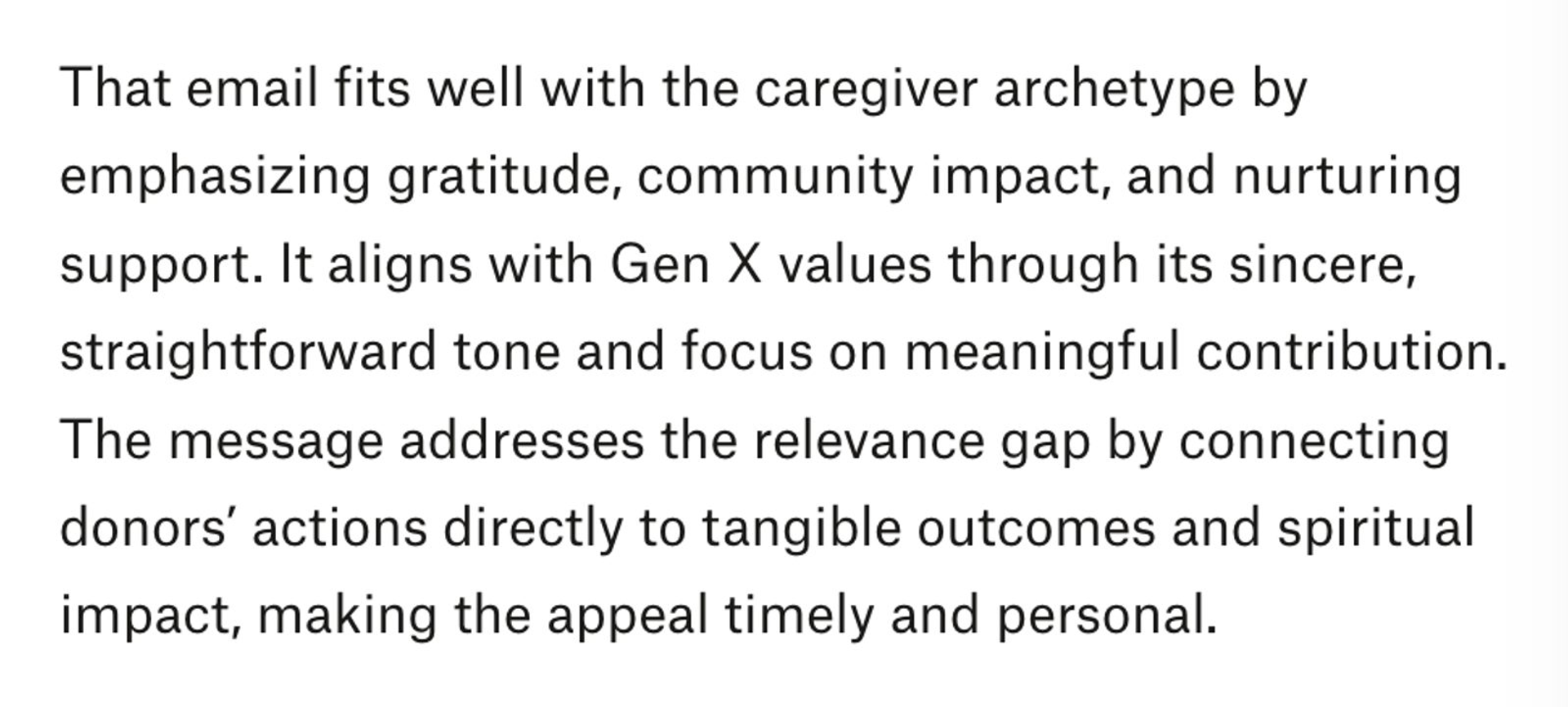
Output from Clarity’s analysis of the original image
Stop being the bottleneck—how to build a strategy that runs without you
Barbara Carneiro didn’t train AI to do less work. She trained it to do her specific kind of thinking: the pattern recognition, the framework application, the judgment calls she’d spent 20 years developing. The payoff wasn’t just that strategy got faster. It was when her team stopped needing her in the room.
By turning strategy into a system, Spice Ink made creative thinking easier to execute, not harder to protect. That’s the real promise of autonomous marketing: not faster content—but clearer thinking, applied consistently, at scale.
Ready to do it yourself?
If you’re ready to start training AI to think like a strategist for your business, you’re in luck. We’ve curated resources based on Barbara’s story to help you. Check out:
1. Prompts to train an AI strategist
Resources to replicate Barbara's workflow