How a 30-minute process in Claude Cowork helped this marketer develop a robust content calendar based on real data
AI now gives marketers access to vast troves of data that would have taken weeks to analyze (and that makes for better campaigns).

Brainstorming fresh, relevant content ideas quarter after quarter can be cumbersome for even the most savvy marketer.
Tired of relying solely on keyword research to develop content calendars for B2B clients with an enterprise sales cycle, Jo Kaminska started using AI to bring to her attention conversations in places their audience connect, like online community groups, along with recorded sales calls and support tickets.
Jo, who founded Kairos Lab, an agency that uses SEO and AEO to drive pipeline for B2B SaaS and cybersecurity, uses Claude Cowork to run this “insider” data through a structured qualitative analysis pipeline.
The result:
- A strategic overview document detailing where the audience is in their thinking and current gaps in content.
- A “language bank” containing phrases and words the audience is using.
- A list of prioritized content ideas based on problems the client’s audience is actually discussing. These ideas can become blog posts, webinar topics, scripts, and more.
“Two things make it worth the effort: focus and fit,” says Jo. “Every topic is backed by a pain point of the audience that appears in the data. And because drafts pull from a language bank of verbatim audience phrasing, readers feel the piece was written for them.”
Plus, this process helps Jo find hidden gem content ideas—ideas her clients would likely never discover on their own without this detailed level of data analysis.
Distilling thousands of data points with a little bit of technical knowledge
In the era before LLMs, Jo had worked with a developer using Python to analyze large amounts of data, but thanks to AI, now she can build qualitative data analysis scripts herself in a matter of hours. This tightens the feedback loop between audience and marketer.
“The best part of it is that you don’t have to really do a lot to run this analysis,” says Jo. “We can direct AI and specify our end goal or desired outcome, but the whole process just runs itself.”
Using Claude Cowork, the process starts by extracting and classifying signals from the data into categories like pain points, objections, and desired outcomes and concludes with generating topics by funnel stage.
The broad workflow is:
- Upload qualitative data (like form posts or customer reviews) to Claude Cowork.
- Upload context, including company information, audience and other contextual documents.
- Run prompts to extract the signals mentioned above.
- Cluster those signals into broad themes.
- Build “theme cards” to easily communicate themes to clients and team members.
- Receive a briefing file with custom content ideas and more.
Let’s dive deeper into how it works.
The pipeline to build qualitative insights into your content plan
Follow along with the process using this Notion doc, where you can find exact system prompts and try it for yourself.
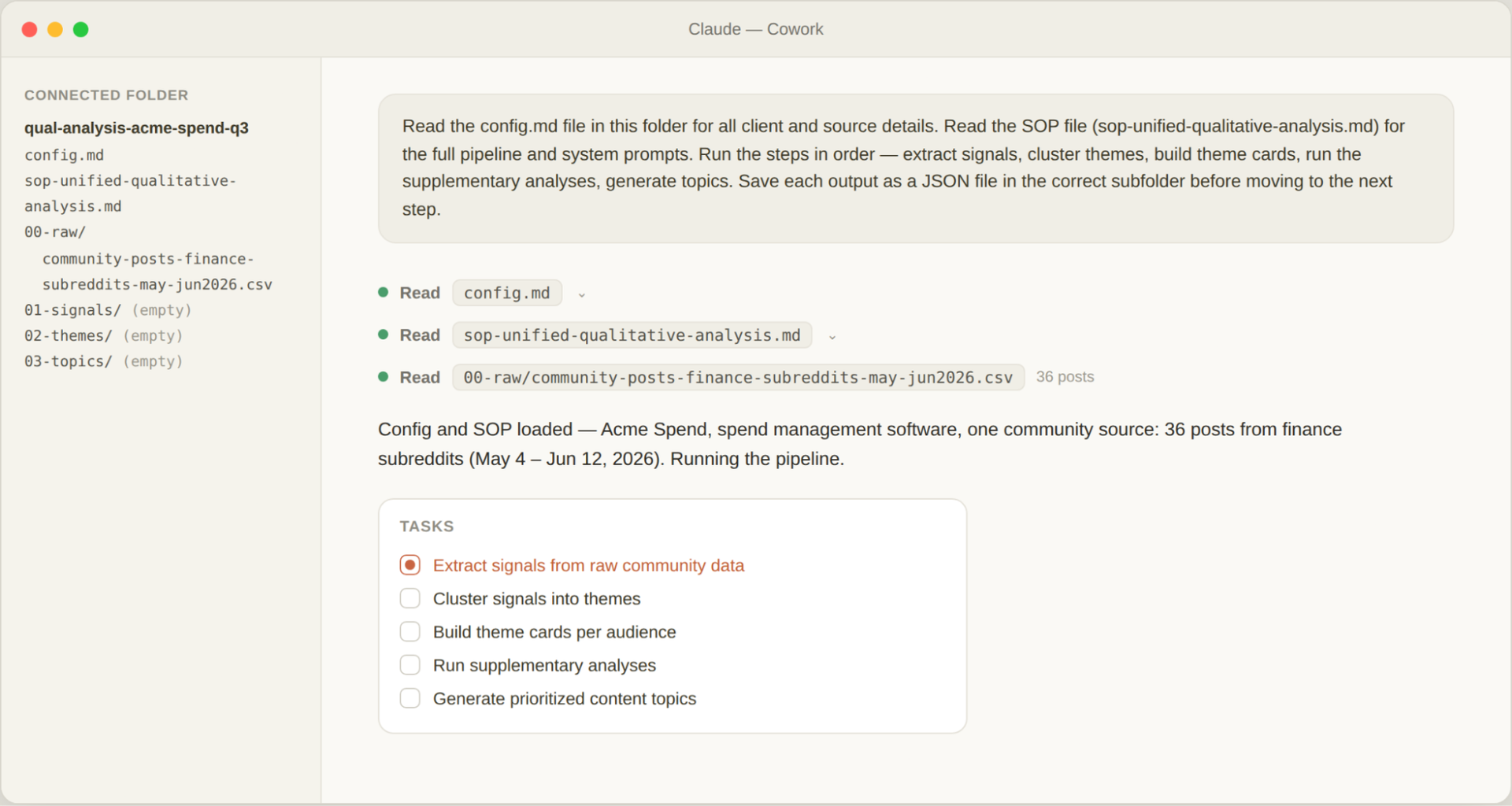
1. Collect and organize raw data. Get all source material into a single working folder with clear file naming. Remember to include a config.md file for Claude Cowork that includes context about the company, personas, etc.
The qualitative data may come from customer and sales call transcripts (export as CSV or JSON from your call recording software), support tickets (CSV export from your help desk), or online communities where your audience gathers
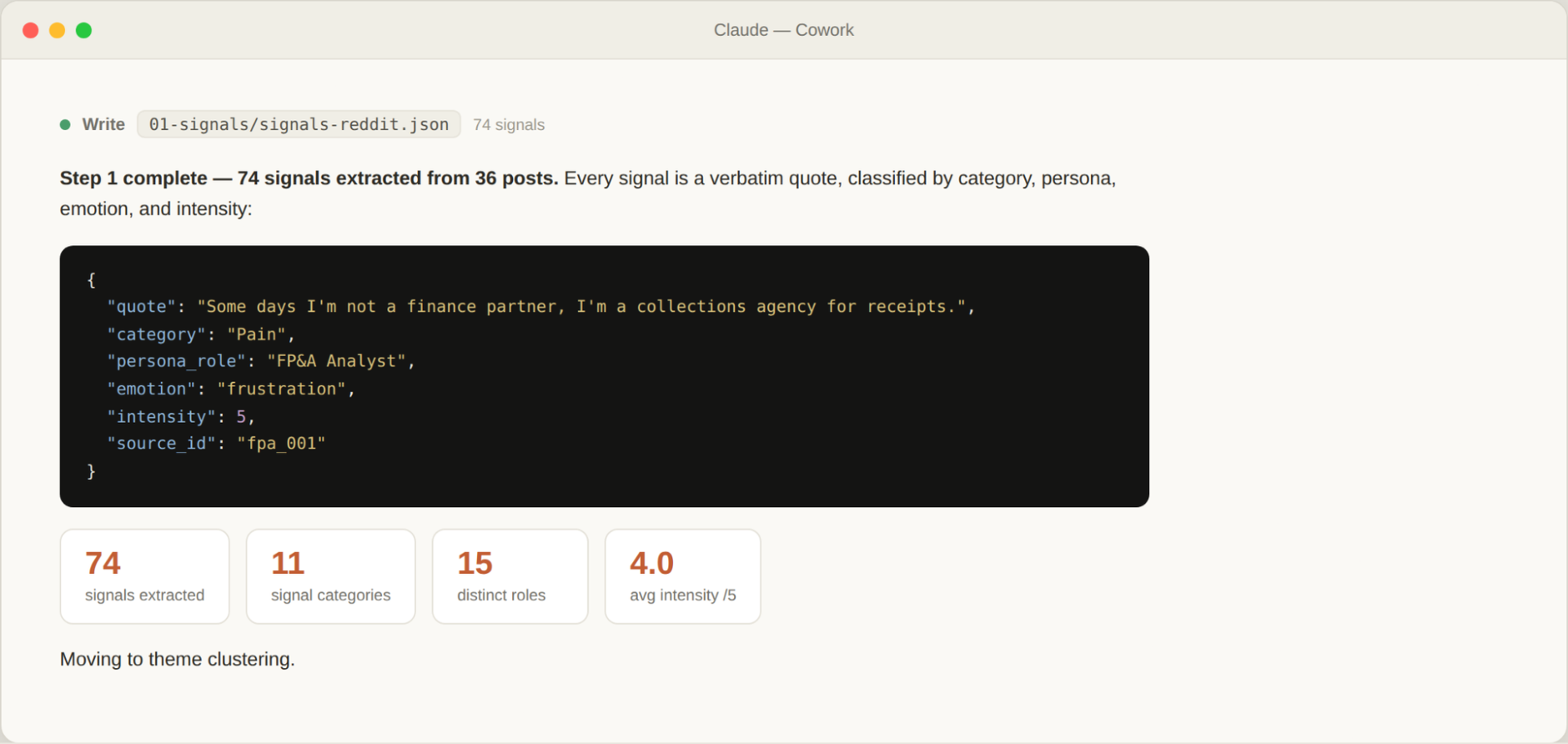
2. Extract signals. A prompt instructs Claude to pull every meaningful verbatim quote from the raw data and classify each by category, persona, emotion, and intensity.
Quote: “Some days I’m not a finance partner, I’m a collections agency for receipts.”
Category: Pain ·
Persona: FP&A Analyst ·
Emotion: frustration ·
Intensity: 5/5
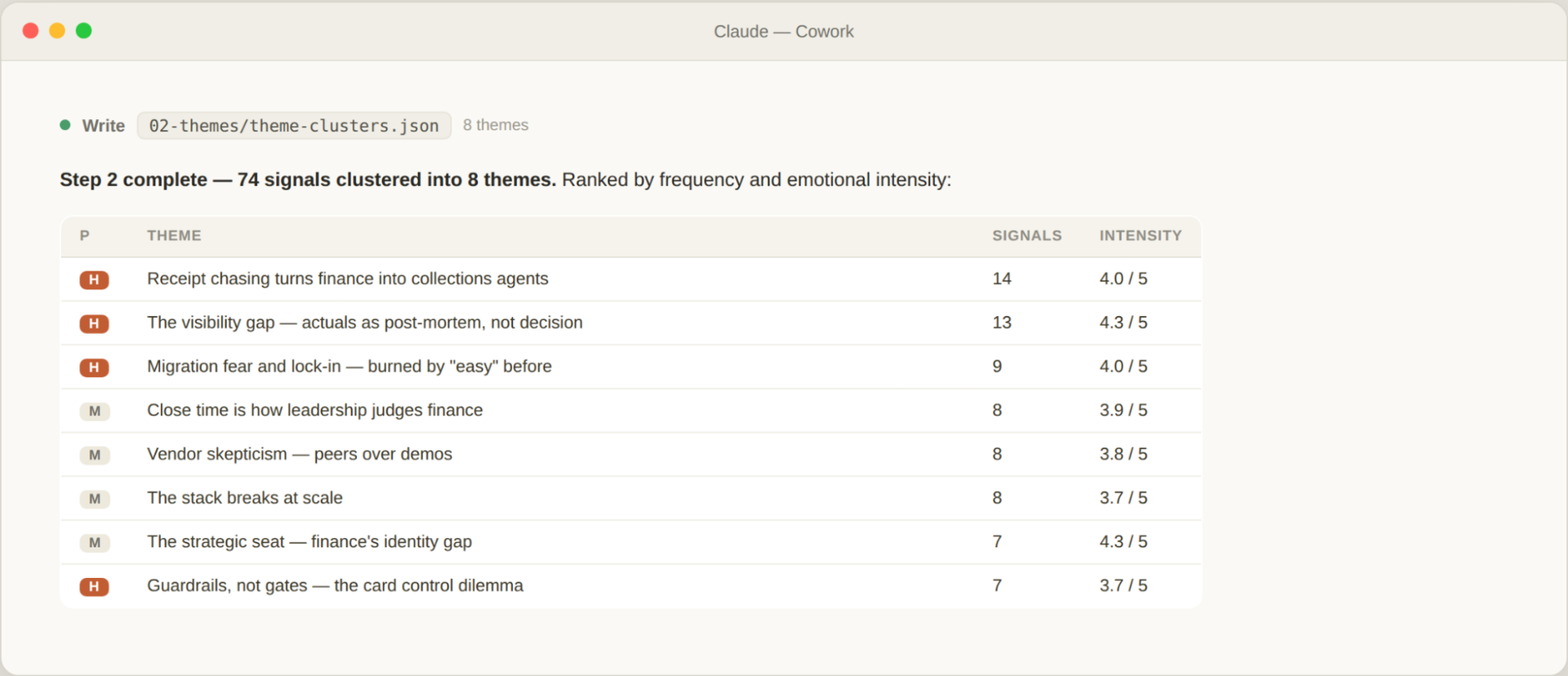
3. Cluster signals into themes. A second prompt groups related signals into 6–10 themes representing recurring audience concerns, scored by frequency and intensity.
In the demo run, 74 signals from 36 community posts clustered into eight themes. Here’s the top one that emerged.
Theme: Receipt chasing turns finance into collections agents—14 signals
Intensity 4.0/5
Personas: FP&A Analyst, Accounting Manager
Month-end is dominated by chasing colleagues for receipts—finance experiences it as an identity problem, not an admin task.
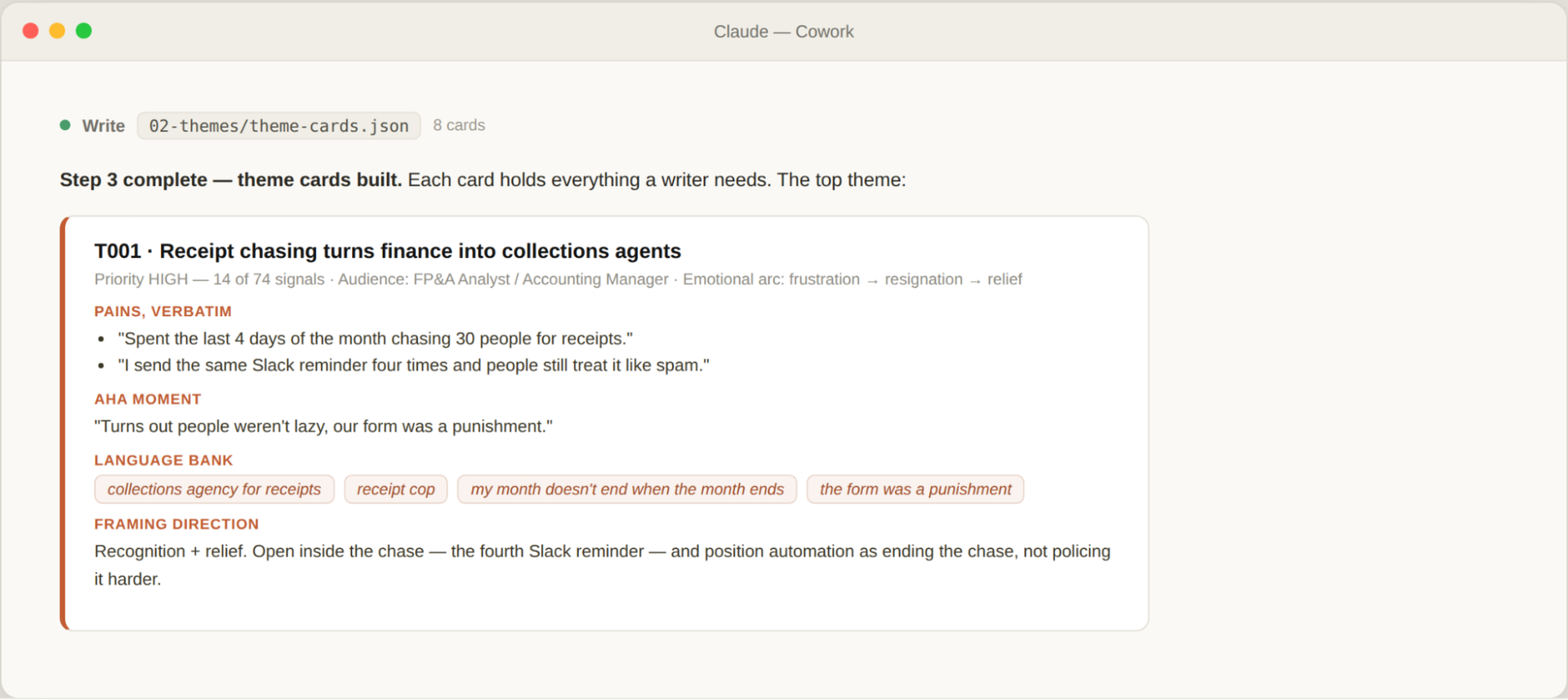
4. Build theme cards per audience. For each theme, Claude builds a “card”: a one-page brief with everything a writer needs to begin production.
Here’s the top card from the demo run.
Priority: HIGH—14 of 74 signals
Emotional arc: frustration → resignation → relief
Their pains, verbatim: “Spent the last 4 days of the month chasing 30 people for receipts.” · “I send the same Slack reminder four times and people still treat it like spam.”
Their aha moment: “Turns out people weren’t lazy, our form was a punishment.”
Language bank: “collections agency for receipts” · “receipt cop” · “my month doesn’t end when the month ends”—the audience’s own phrasing, ready to become headlines and hooks.
Framing direction: recognition + relief. Open inside the chase—the fourth Slack reminder—and position the solution as ending the chase, not policing it harder.
5. Run supplementary analyses. Layer additional qualitative lenses on top of themes to make even smarter, sharper content decisions. These additional lenses include:
- Frequency analysis, which outlines the themes mentioned the most and with the most intensity.
- Discourse analysis, which adds context on how to write—for example, in one dataset, Jo learned the audience uses dark humor as a trust signal, helping to guide writing style.
- Emotional mapping, which helps to determine angle.
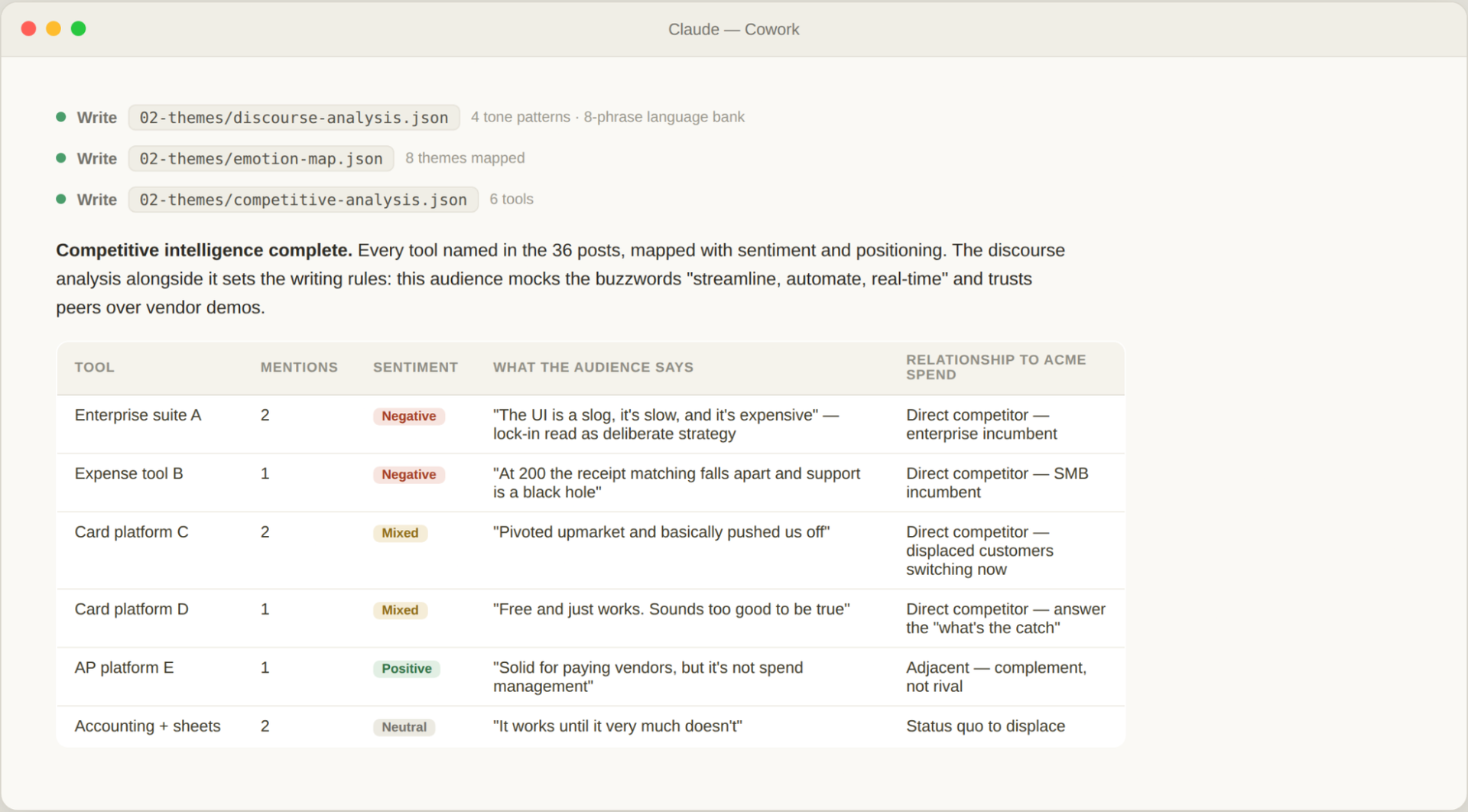
- Competitive analysis, which notes competitor tools the audience mentions.
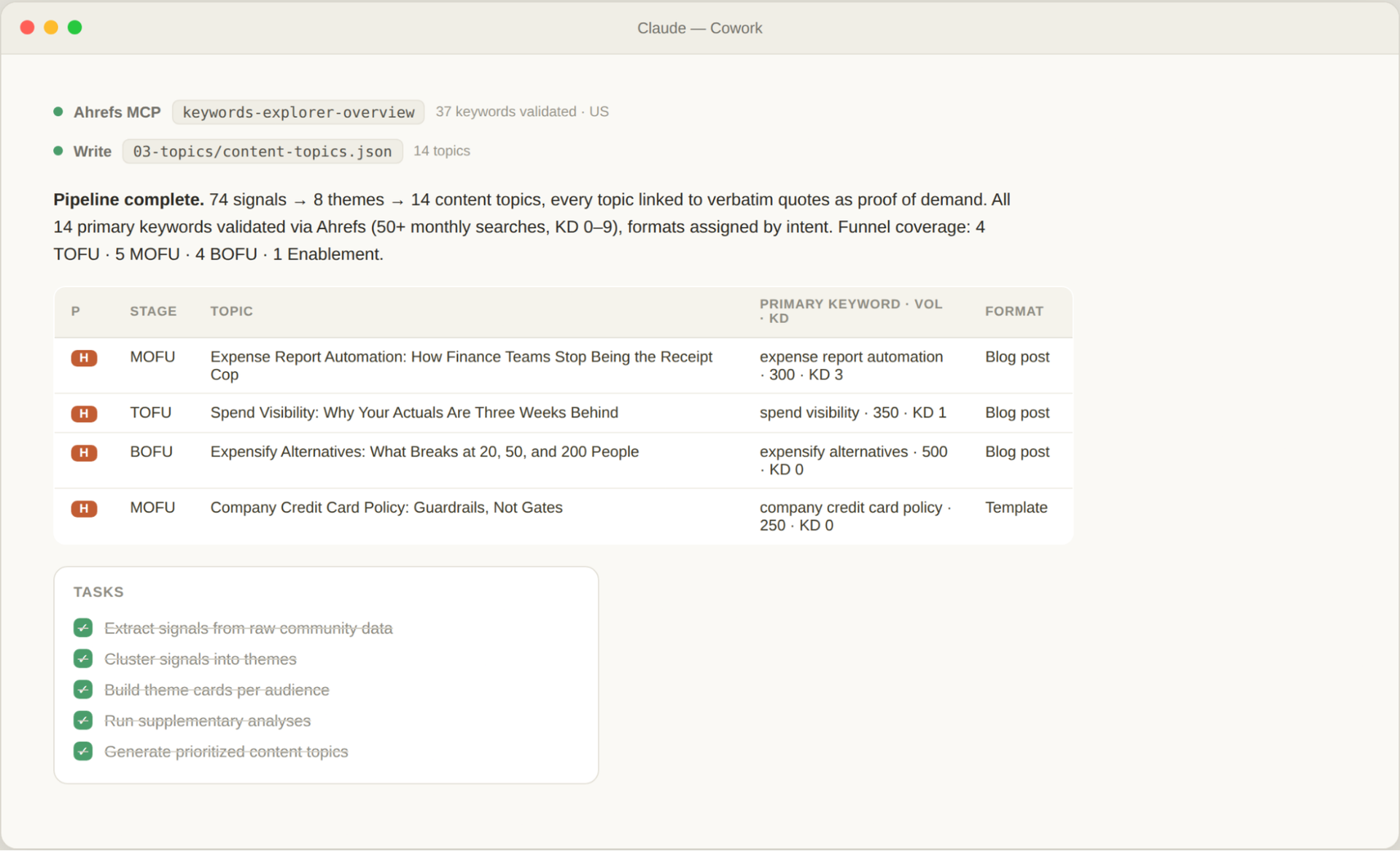
6. Generate content topics. A prompt converts the cards into a prioritized list of ideas—with each topic linked to the quotes that prove this is a topic worth writing about.
Each title leads with a primary keyword validated against Ahrefs (connected to Cowork via SEO tool MCP), to track real search volumes and keyword difficulty.
Here are sample rows from the demo run.
Before a client sees an idea, the output goes through a quality checklist:
- Every theme needs at least three quotes as evidence.
- Every topic must link to a source signal as proof of demand.
- The language bank must contain actual audience phrases.
- The calendar balances funnel stages.
The end result: A prioritized, customer-focused list of content ideas
In about 30 minutes, Jo was able to distill thousands of data points into actionable, high-quality SEO/AEO content ideas, targeted to her client’s audiences and their specific pain points and desires.
The content ideas shared in the output—the provided topic briefs—can be used across various channels, from organic to webinars, newsletter ideas, support guides, and more.
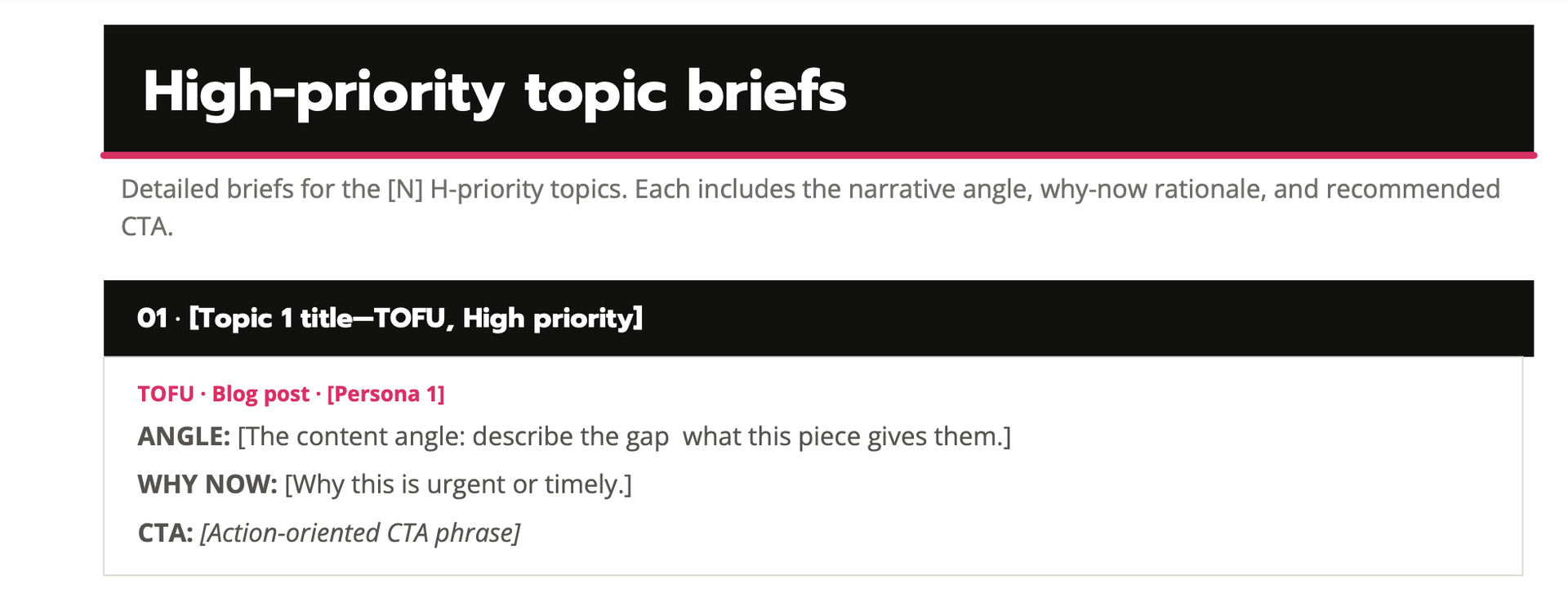
In one example Jo shared, the data found the audience was underequipped, not uneducated, which enabled the team to switch content strategy from education to templates, scripts and enablement. Three topics went into production immediately because the community was crowdsourcing those exact answers.
I never would have come up with this topic myself, and I would never find this particular topic in this amount of data.
When a stakeholder asks “why this topic?”, Jo has a concrete answer because evidence backs every editorial decision: “Our audience brought this up 35 times in three months with high emotional intensity, and no one is giving them a clear answer.”
Related
More data from the AI Lab.


