“Can we build this internally?” How the world’s No. 1 prayer app is replacing thousands of dollars of software using AI tools
How Hallow uses AI tools to build the exact tools they need—so the team can focus on what it does best: content.

With tightening budgets and an ever-growing need for a tech stack that helps marketers do their jobs better, sometimes it just makes more sense to go the DIY route using AI tools.
“When tools are expensive, it’s worth exploring how you might be able to save money by building something yourself,” says Stephen Spiewak, the director of organic marketing for Hallow, the world’s No. 1 prayer app.
The default at Hallow is to think about ways to create solutions internally using tools like Claude Code and n8n before potentially investing in external marketing software. A lot of the pain points Stephen and his teammates build for these days are repeat tasks like creating ads for Meta and monitoring ongoing campaigns on social media.
“I think things with a regular cadence make sense [to build yourself],” he advises.
And while no single piece of software exists for the exact tools Stephen has built at Hallow, he estimates they’re replicating a SaaS bundle that would run somewhere between $10K-$25K.
Vibe coding thousands of dollars of SaaS products
Here are two examples of how Stephen and the team at Hallow have vibe coded tools to help monitor campaign success and develop a process for launching a steady cadence of Meta ads.
1. Building a social sentiment dashboard for a major campaign launch
The background: After a campaign launch in February, Hallow’s marketing and leadership team wanted to understand the at-a-glance, general sentiment on social media around the project—a 40-day prayer challenge during Lent.
“A lot of times the conversation can happen about your brand without you necessarily being tagged. If you’re not actively monitoring where your brand is appearing, you can miss those conversations,” Stephen says.
Hallow’s C‑suite didn’t want to see every single X post or Instagram comment throughout the month-long campaign; they just wanted a big-picture view of the conversation online among their audience.
The pain point: There are lots of products on the market that help do this for brands, but the issue Stephen kept running into was that the software he vetted offered functionality far beyond what he needed.
I kind of thought to myself, hey, instead of investing in one of these tools that does a lot of things when we only really need one thing, can we just build that one thing ourselves? I felt pretty confident we could.
The workflow: Stephen used n8n, a workflow automation platform, to create a social sentiment dashboard to monitor the conversation around the brand across different social media platforms.
Here’s how it works:
- A crawler that runs through n8n scans different social platforms for mentions of Hallow on Instagram, X, TikTok and Reddit.
- Mentions are sent to ChatGPT.
- ChatGPT assigns a sentiment to each mention of “positive”, “neutral”, or “negative” and a score from ‑1.0 (most negative) to 1.0 (most positive) along with a reason for the score with one sentence explaining why.
- The tool creates an average score for the day and a chart of the day’s result, along with links to individual social posts for a deeper dive if any score highly in either direction.
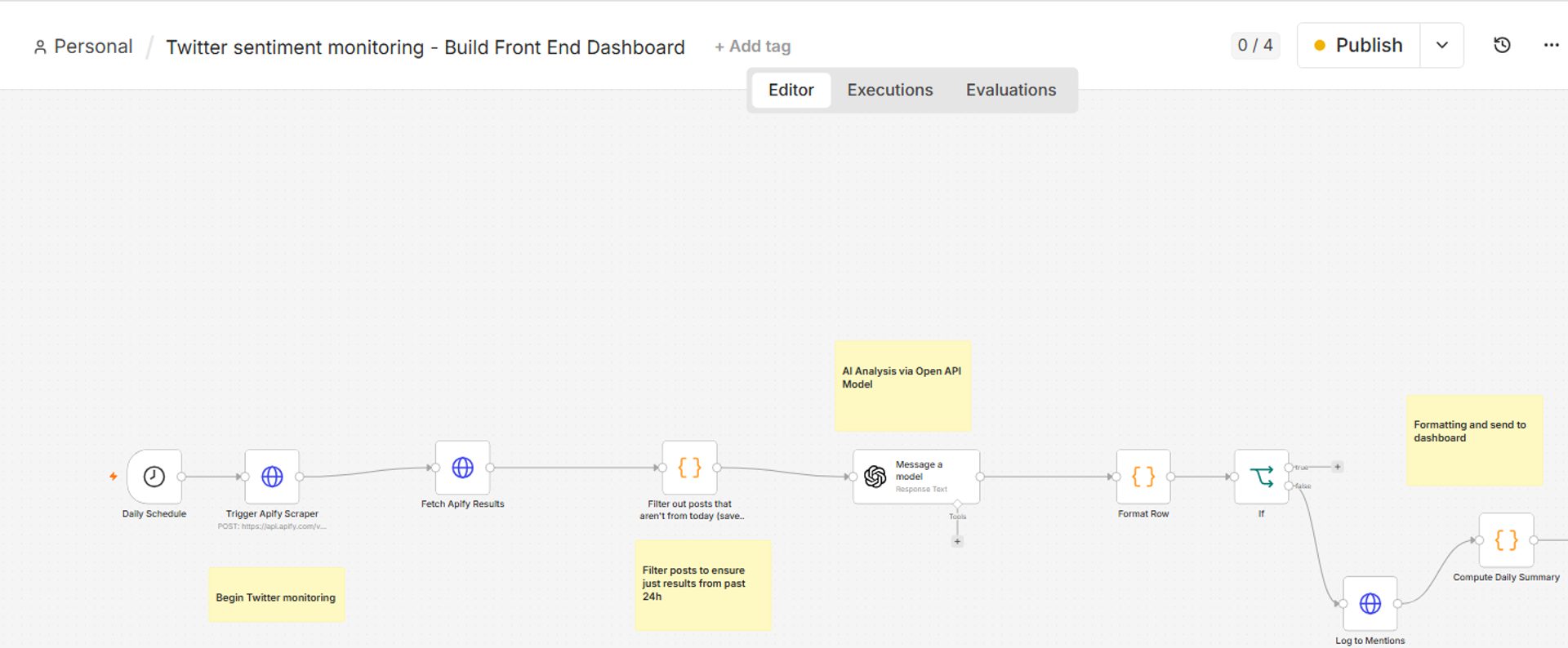
The n8n workflow used for social monitoring
The end result: The exact tool the Hallow team needed, with no extra bells and whistles: an interactive dashboard that offers a snapshot of the conversation on social media, but also allows the team to drill down by individual channel or post for a more in-depth look.
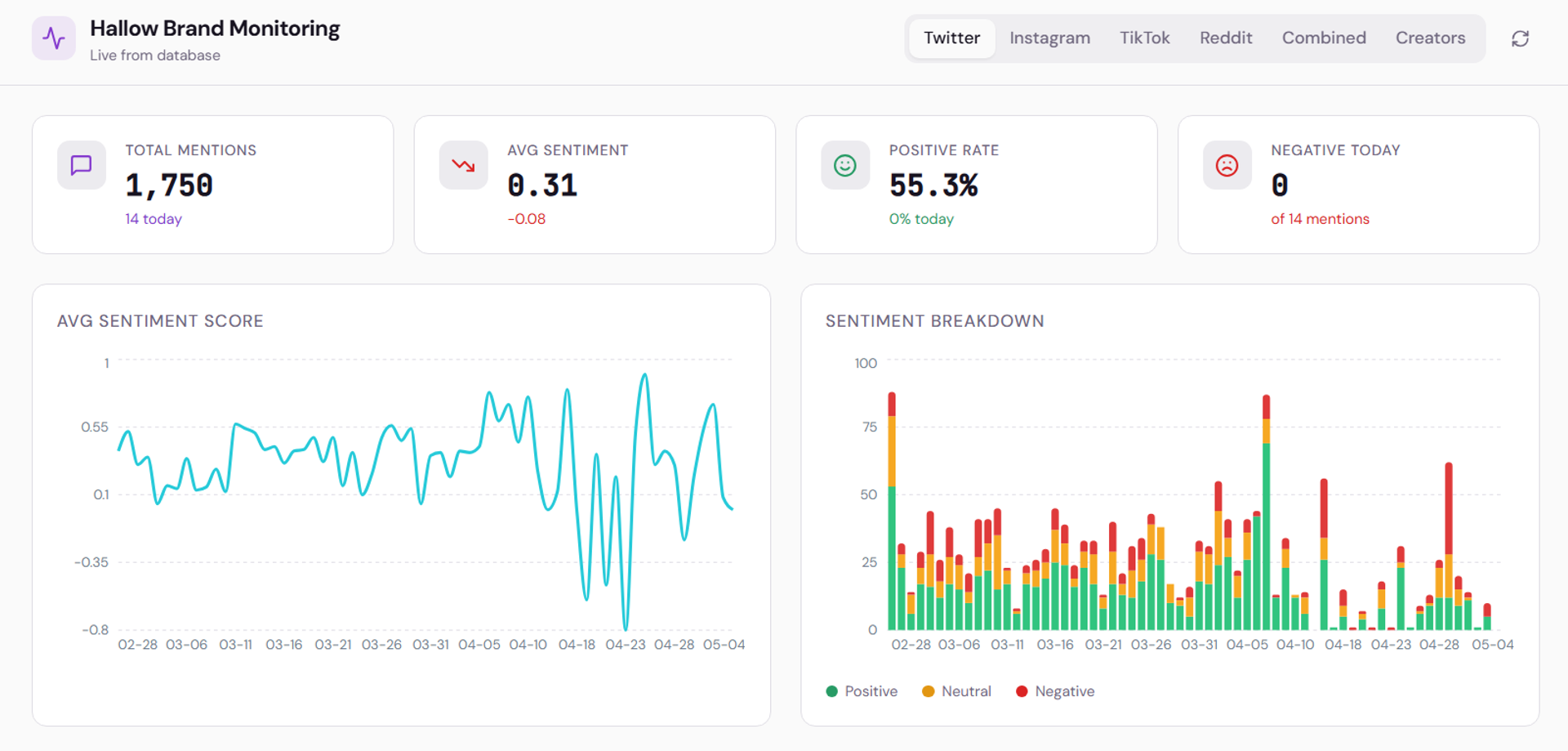
The at-a-glance sentiment dashboard
“We looked at tools, and many of them tried to bundle publishing, influencer, and other social-related functionality we didn’t need to pay for,” he says. “We were able to build exactly what suited us, for our specific needs, at a fraction of the cost.”
The Hallow team recently replicated this framework to assist in some of the UGC work they’re doing with creators on behalf of the Hallow app.
“The same framework helped us to see data from each creator about their impressions and reach, which posts were gaining traction and generating a lot of comments,” he shares. “The marketing team was especially excited that this tool can help us figure out which creators we want to keep partnering with.”
This project also offered some unexpected insights about generative engine optimization or GEO.
“We’re exploring repurposing the basic framework of monitoring and analysis to be helpful for understanding our visibility in AI search,” Stephen explains. “Search is getting more social and there are a lot of similarities with how we’d want to understand how we are showing up in LLMs.”
2. Creating a seamless, custom process for deploying ads on Meta
The background: Meta is an important channel for the Hallow team, who promote the app through Facebook and Instagram ads. The activity on Meta helped the team reach No. 1 overall in the App Store on the Christian holiday of Ash Wednesday.
In 2026 so far…
Hallow has launched 25,000+ ads across all campaigns and markets, shipping 1,000+ ads a week during peak periods. That’s a lot of ads—and a lot of assets for any one marketer or team to keep track of.
The pain point: Manually building, duplicating, editing, and launching ads in Meta’s UI became cumbersome and time-consuming.
Stephen and his teammates wanted to find a way to use Meta’s API documentation to build a custom platform to launch ads via templates, duplicate ads, and manage the process more quickly than ever before.
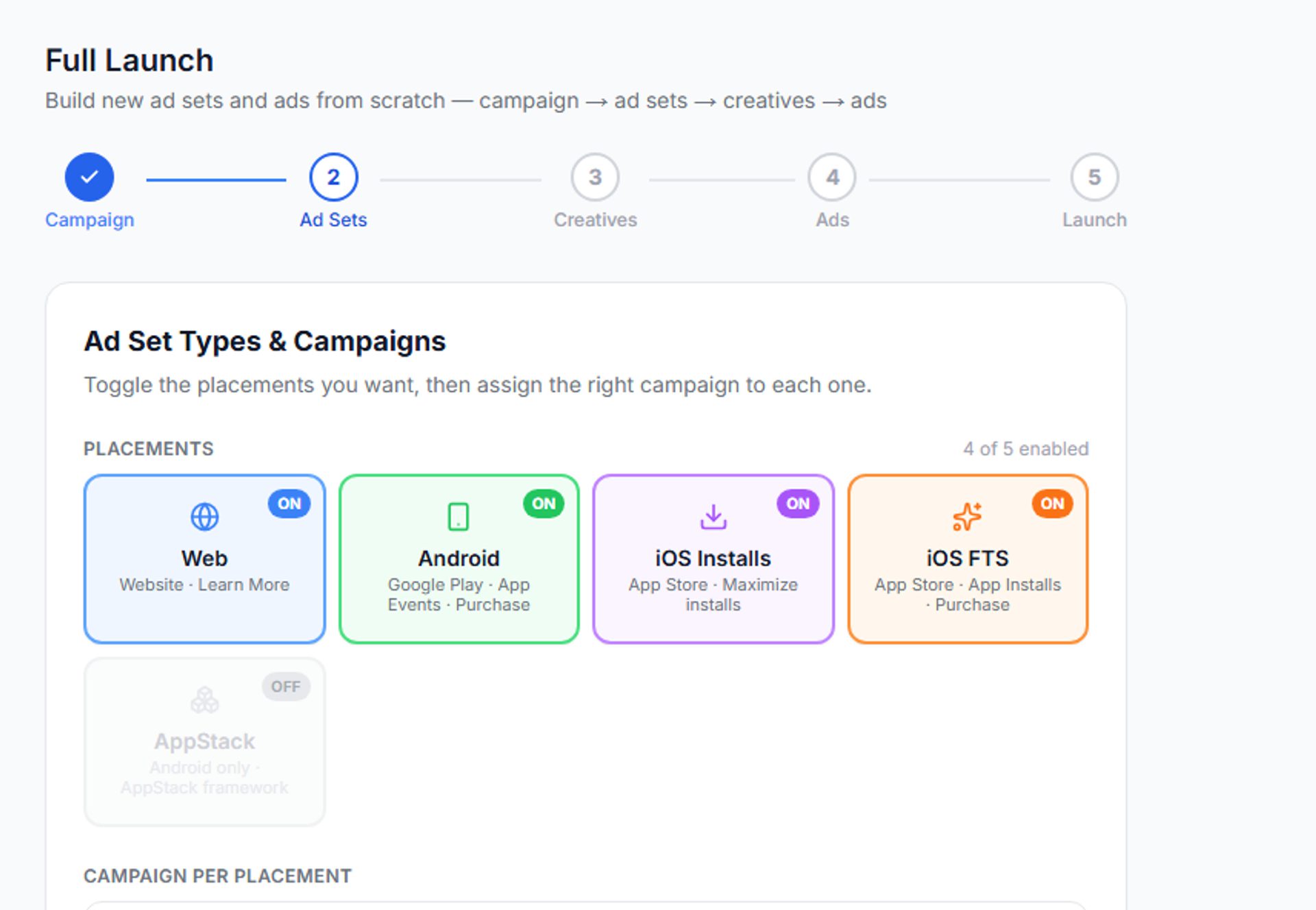
The workflow: Stephen uses Emmaus, an internally created and named tool, to upload ad creative en masse.
It automatically matches image and video files that are the same asset, but sized differently, and places ads in the correct placement for each platform—like 9x16 for Stories or 1x1 for Feed posts.
“We also have a Google Drive option, where you can drop a link to a folder where our design team has already uploaded assets, and the tool automatically downloads them and uploads them to Meta again in the correct sizing,” Stephen says.
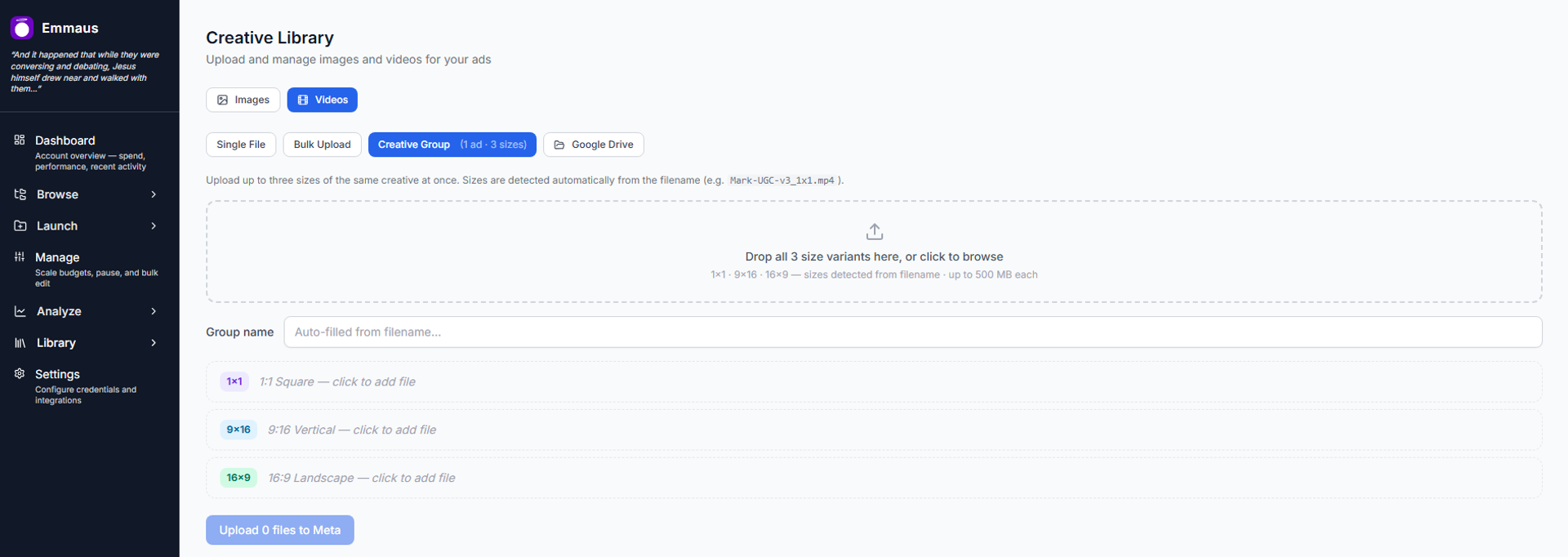
The Emmaus app vibe-coded by Hallow
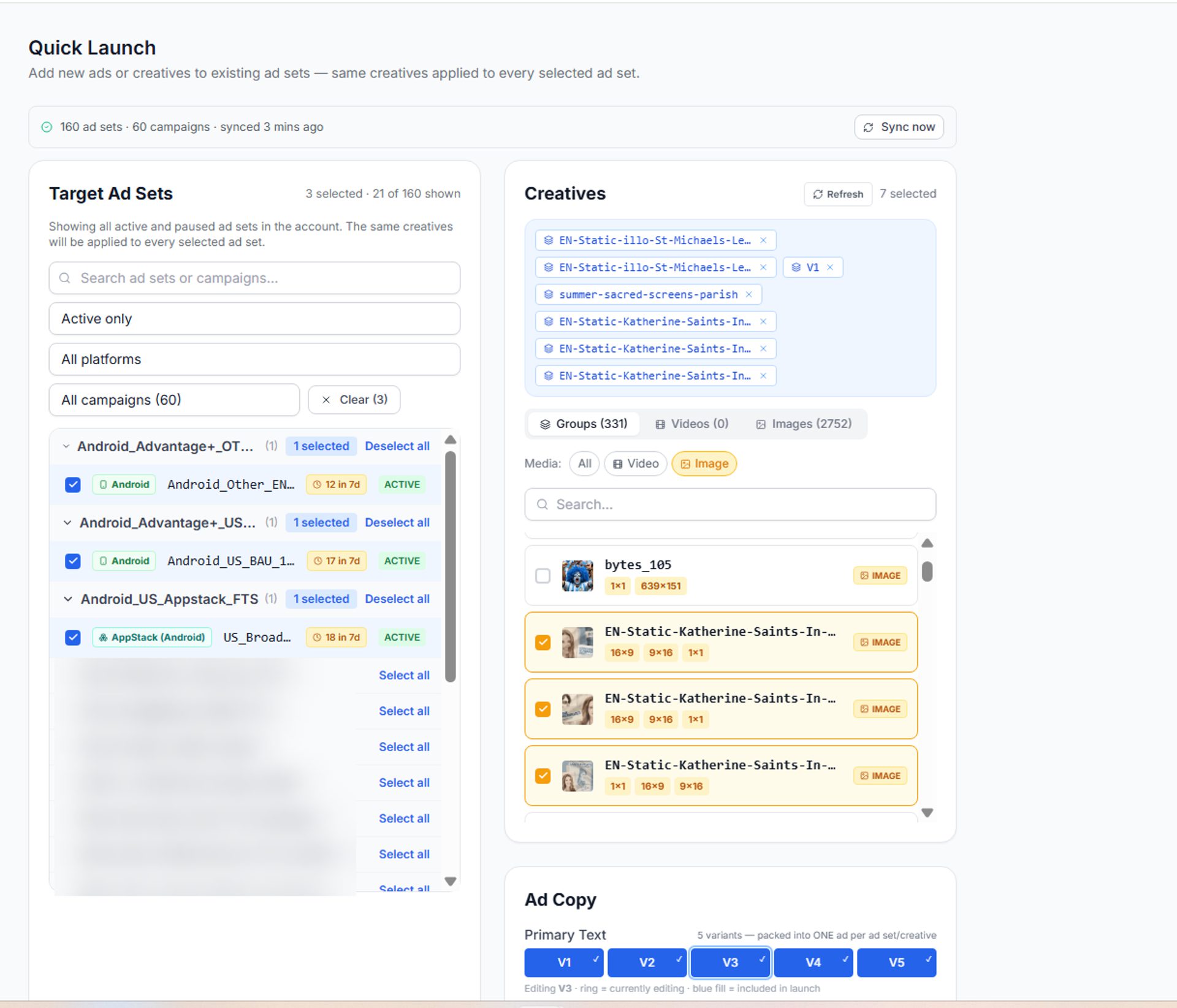
An ad campaign manager vibe-coded by Hallow
Once the creative is uploaded, Emmaus allows users to launch the assets across however many campaigns and ad sets at once.
“If we choose three creative groups, and launch across five different ad sets, we create 15 ads with one click,” Stephen says.
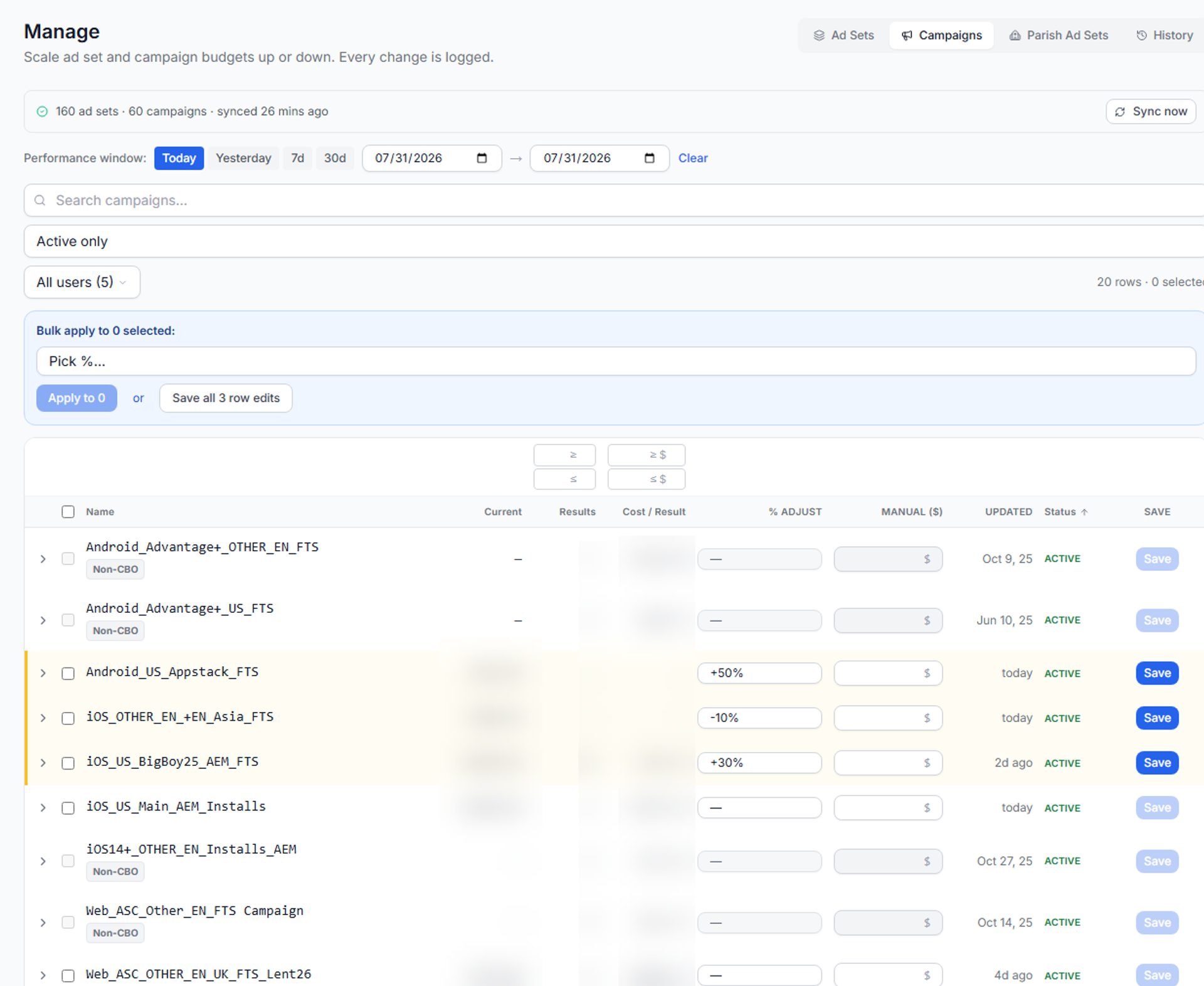
Once the ads are live, the team can manage budget, rapidly scaling up or down.
“Instead of individually changing budgets by hand, preset values allow us to move quickly,” he says.
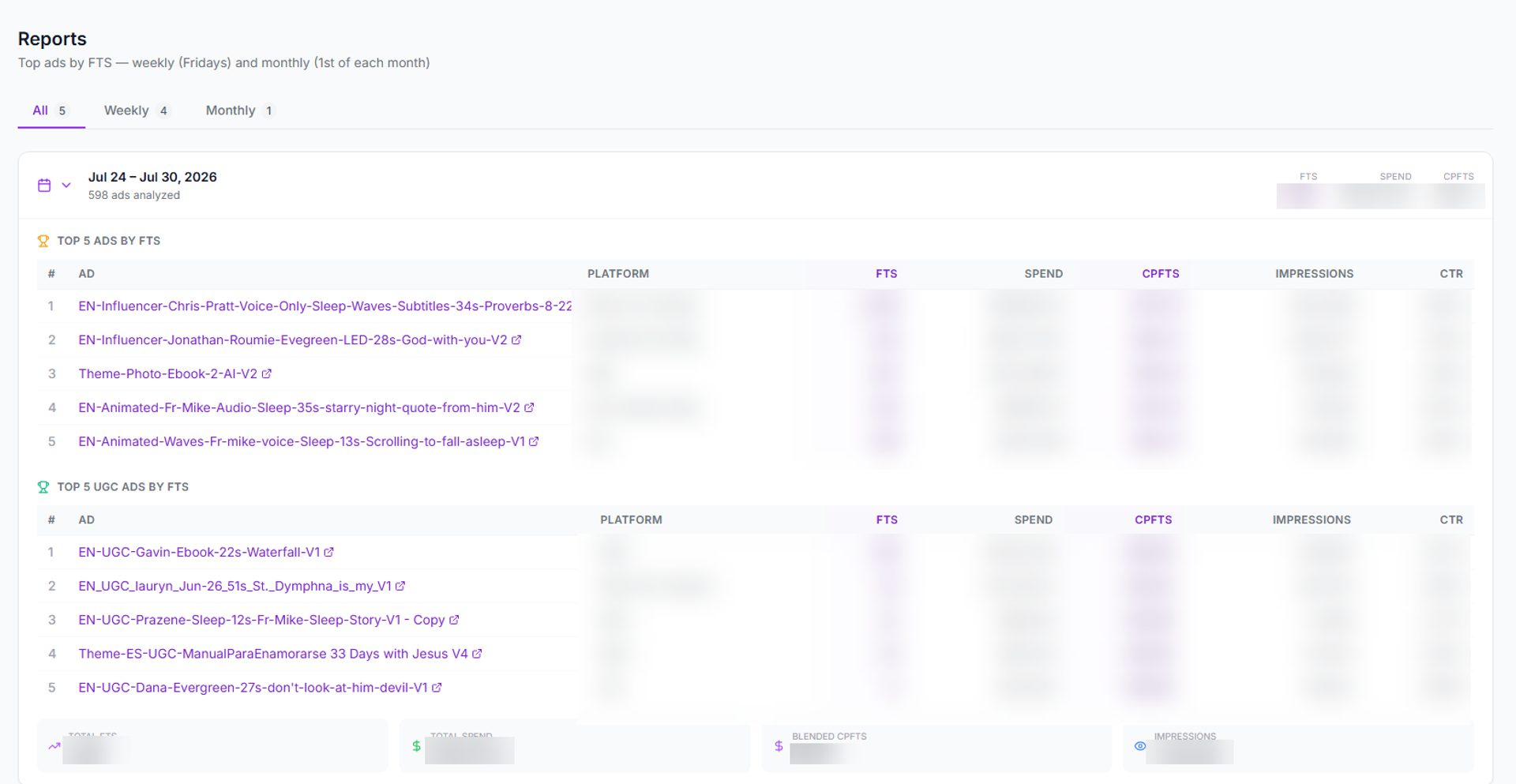
The end result: A lot of time saved creating ads, but not time savings in the way you think.
This level of time saving allows Stephen’s teammates to launch ads quicker and discover which ads actually work to scale and reach more people so they can make more smart ads that work.
“If it only takes us this amount of time to launch 50 ads; all right, we can launch 100 ads in the normal amount of time, and then find more winners,” he explains.
Take note: AI doesn’t have a soul
There’s one area the Hallow team doesn’t use AI: for their prayer and meditation audio content.
“We’re a content company. We invest in high-quality, well-researched audio content. We have an extremely high bar for content in the app,” Stephen says. “It’s all heavily researched and vetted by humans.”
The reason for that?
Our content is written by someone with a soul. AI has no soul. AI is a machine and a tool, but it can’t accurately guide someone in their faith.
Even with a hard stance on not using AI for the app’s thousands of pieces of produced content, Stephen says there are plenty of opportunities and areas the team is bullish about leveraging AI to help them work smarter — while keeping humans involved in the process.
“Emmaus, our Meta tool, is really helpful for making it easy and fast to launch and scale up/down ads, but the actual decisions to launch creative, set budgets, and organize campaigns are all done by humans,” Stephen explains. “The AI tool allows our talented team members to focus on what they do best and let their skills and talents shine rather than get bogged down with rote tasks.”
Empower yourself—and save the budget for what really matters
With a 15-year career spanning journalism, public relations, and marketing, Stephen believes AI can help to level the playing field for people who don’t have coding or technical expertise.
“Tools like n8n and Claude Code are extremely empowering,” he said. “You don’t need to be a super technical person; you don’t need to be an engineer.”
And while it helps to have a bit of technical knowledge—like a familiarity with API documentation or JSON—you can dive in pretty seamlessly without a ton of experience.
“It allows us to build things that our team needs without many external resources and without a super strong technical background,” he shares.
Besides the obvious cost savings when an internal tool does the job, “even if you fall short, getting your hands dirty with building something will probably help you understand what exactly you need in software before you invest in it,” he says.
Related
More data from the AI Lab.

