He turned his product marketing process into an AI teammate

Harsha Kotthapalli used to spend weeks writing messaging for a single marketing campaign.
As the Founder of product marketing firm Kernel, Kotthapalli has developed his own ways of approaching research, competitive analysis, positioning, messaging, and go-to-market (GTM) strategy. He has since turned those methods into reusable Claude skills – a system he’s nicknamed his “product marketing teammate” – that he uses across his freelance work.
Instead of starting from a blank chat for every project, Kotthapalli gives Claude the processes he would normally follow himself: one skill conducts competitive research, while another applies his messaging framework, and so on.
With his AI teammate by his side, Kotthapalli says creating a campaign that used to take weeks now takes just an afternoon.
Here’s how he built a product marketing teammate around the way he already works and how you can do the same.
Don’t ask AI to do product marketing. Teach it how you do product marketing.
Kotthapalli’s system starts with something he had before Claude: his own process.
Over almost eight years in product marketing, he developed frameworks for the major parts of the job. He knows what questions he asks during market research, has a structure for competitive analysis, and has his own messaging matrix.
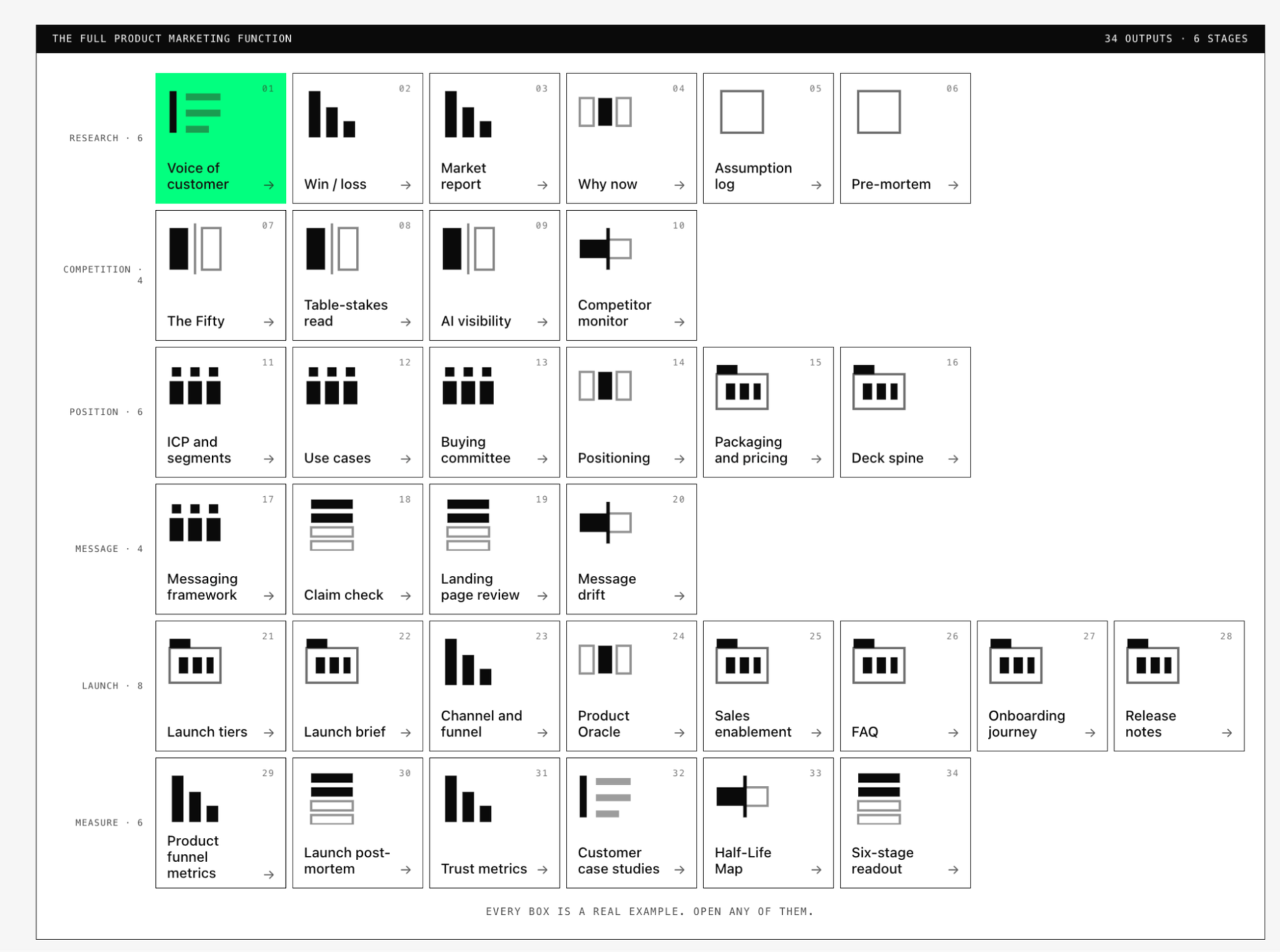
An overview of Kotthapalli’s product marketing framework
“I have a framework and methodology for each aspect,” he says.
Instead of repeatedly explaining those frameworks in new chats, Kotthapalli turns each one into a reusable Claude skill.
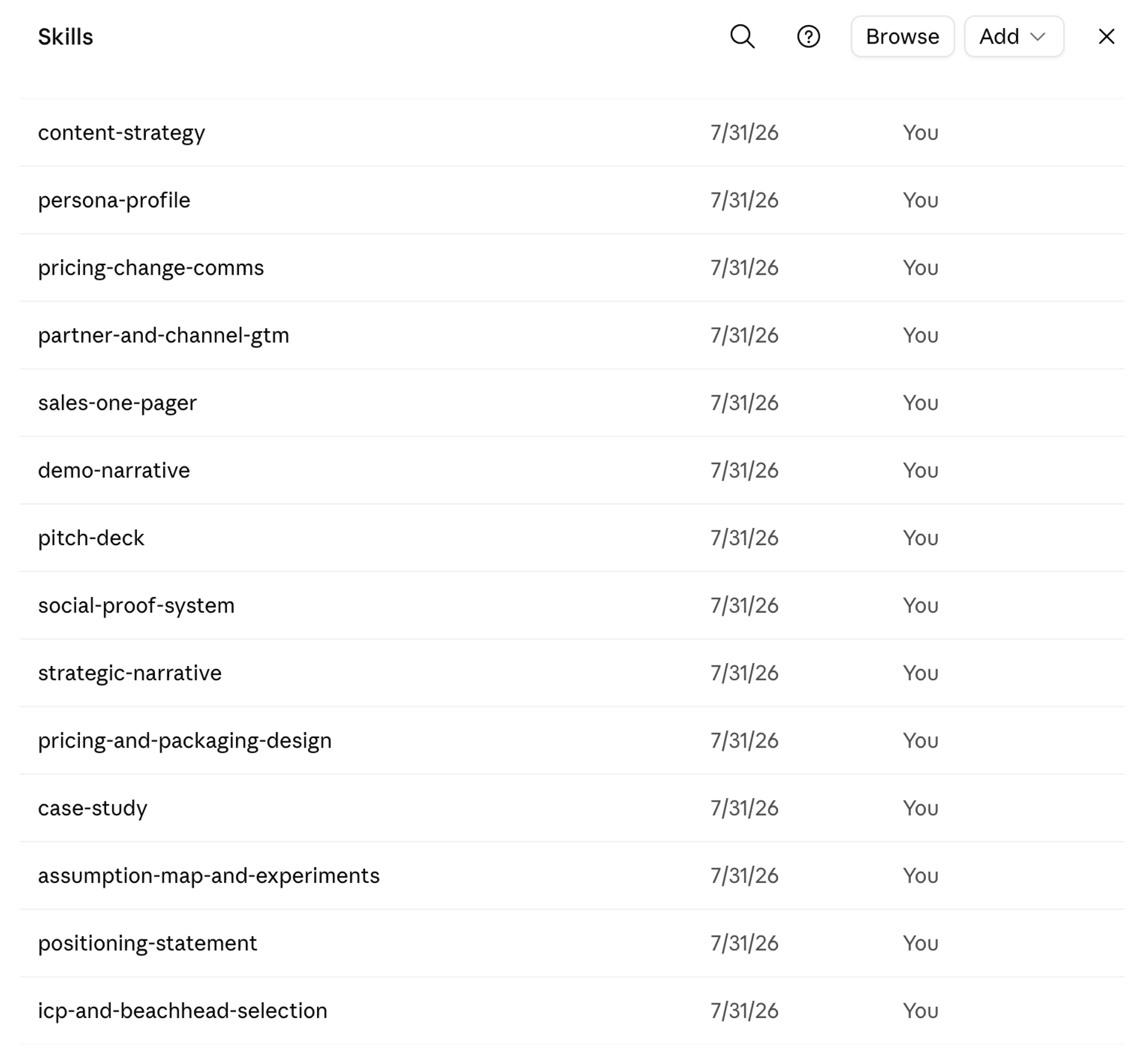
Just a few of the product marketing Claude skills Kotthapalli has created
For competitive research, for example, Kotthapalli gives Claude the markets he wants to investigate, the questions he wants answered, and the process he uses to identify gaps.
“I have a framework for competition,” he says. “I fed it to Claude and said, ‘This is what you need to do. Set up the instructions.’ Claude makes a Markdown file and saves it as a skill.”
His competitive-analysis process runs through roughly 50 questions that collect information and turn that information into a marketing decision.
For example, the analysis might find that a company’s advantage is that it’s the only competitor to offer a particular feature. The takeaway is that this feature deserves the spotlight when it comes to positioning.
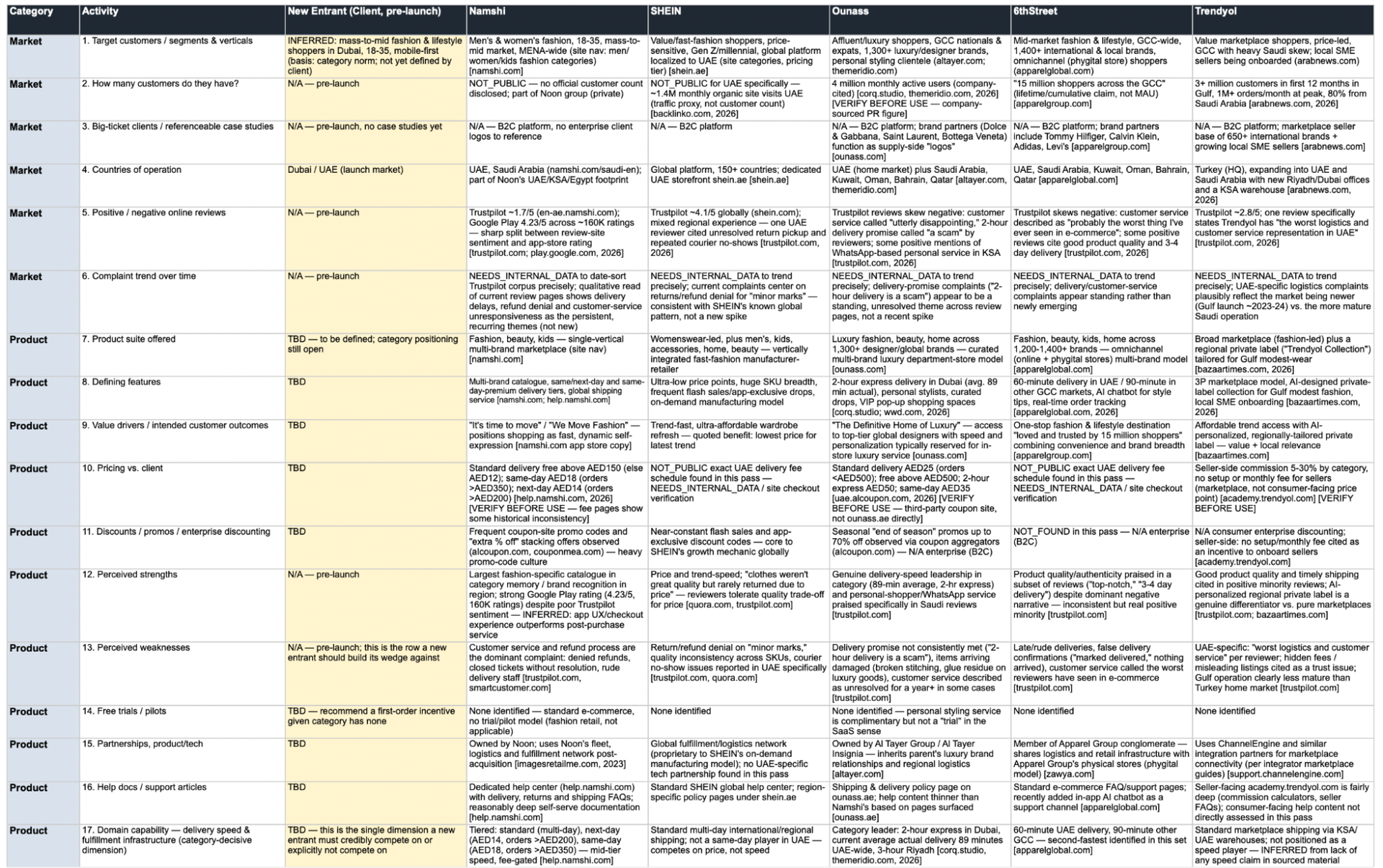
Kotthapalli demonstrates his Claude competitive analysis skill by comparing fashion apps
Kotthapalli has seen a dramatic difference in how long this kind of research takes. Before AI, he says, a junior product marketer working with him on a similar competitive-analysis project would spend about a month on it. During our interview, Claude worked through his competitive-analysis skill in roughly 10 minutes.
Step 1: Turn a repeatable process into instructions AI can reuse
Kotthapalli’s advice for building an AI teammate starts before you open Claude.
“Map out your process,” he says.
Because a Claude skill is a set of instructions that the AI saves and applies to similar tasks, creating a skill involves getting your method out of your head and turning it into a form AI can follow.
For Kotthapalli, that means identifying three things:
- Inputs: What information does the task start with?
- Questions: What do you consistently need to find out?
- Decision process: How do you turn those answers into a recommendation or output?
In the time before Claude, Kotthapalli’s frameworks existed as spreadsheets and templates. To feed these frameworks to Claude, he didn’t need to write any code. Instead, Kotthapalli uploaded his frameworks to the AI, explained the output he needed from each task, and then asked Claude to turn the process into reusable instructions for itself.
After creating a new skill, Kotthapalli tests it by seeing what outputs Claude creates and adjusting the skills, as needed. For example, when he created his buying committee skill and ran it on UAE-based expat financial planning app Wealth Karma, which Kotthapalli co-founded and served as CMO, Claude initially only created output for the B2C version of the product. Kotthapalli improved the skill by instructing it to also consider Wealth Karma’s B2B offering for employers.
Want to create your own skill in Claude? Start by documenting how you would explain the task to a colleague who needed to repeat it without you.
“For each step in the process, try to make a skill based on how you work,” Kotthapalli says. “My way of doing market research would be a little different from your way of doing research.”
That distinction matters. A generic AI model knows what a go-to-market strategy is, but it doesn’t automatically know what you consider a good one.
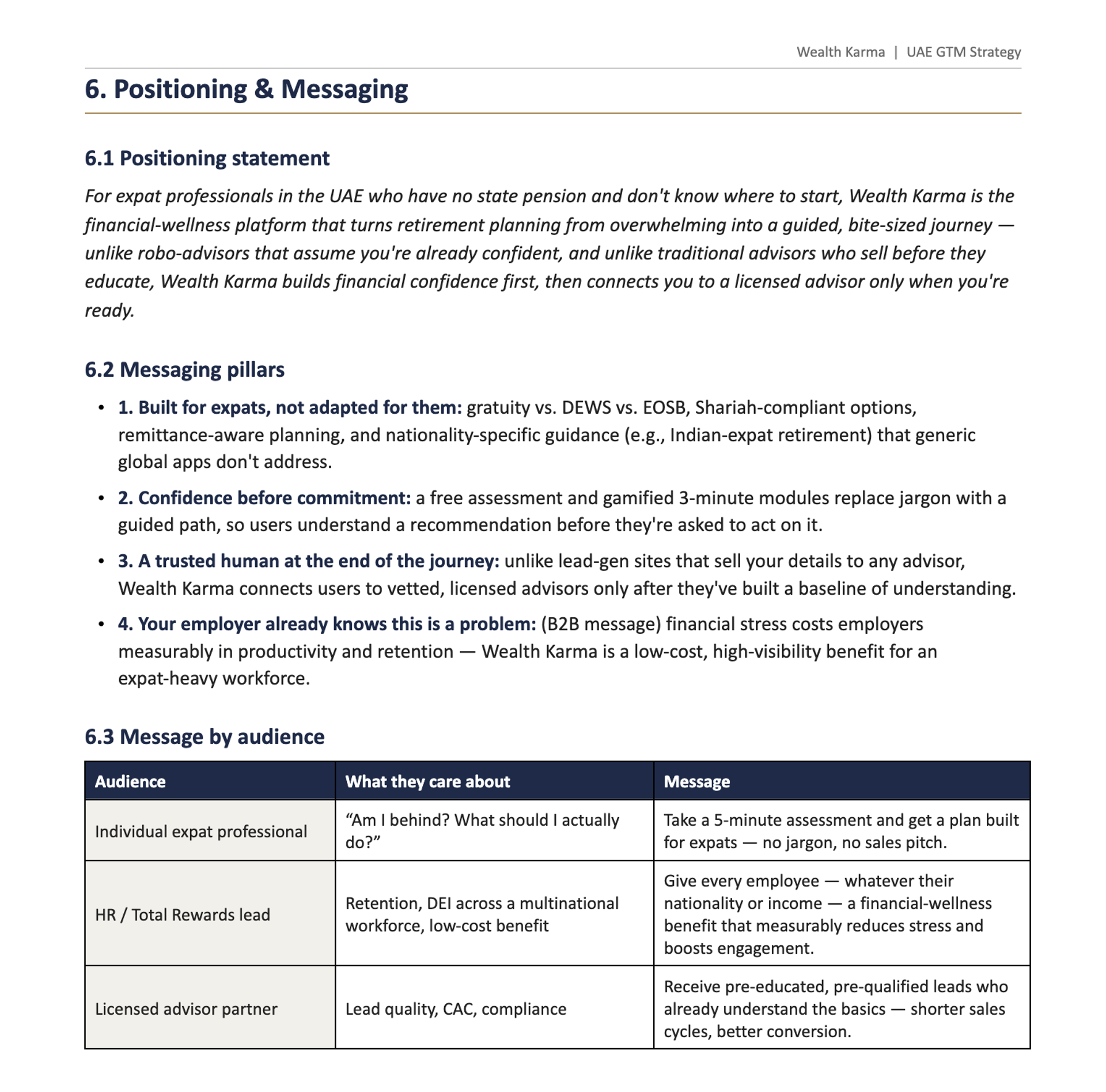
An excerpt of the generic GTM strategy AI produced for Wealth Karma without Kotthapalli’s product marketing skills
“If I just give it a prompt to make a go-to-market strategy, it would be very generic and not structured,” he says.
Feeding the same exact prompt to Claude, which is equipped with Kotthapalli’s product marketing skills, breaks the work into specific areas such as customer segments, segment scoring, buying committees, positioning, pricing, messaging, and win/loss analysis.
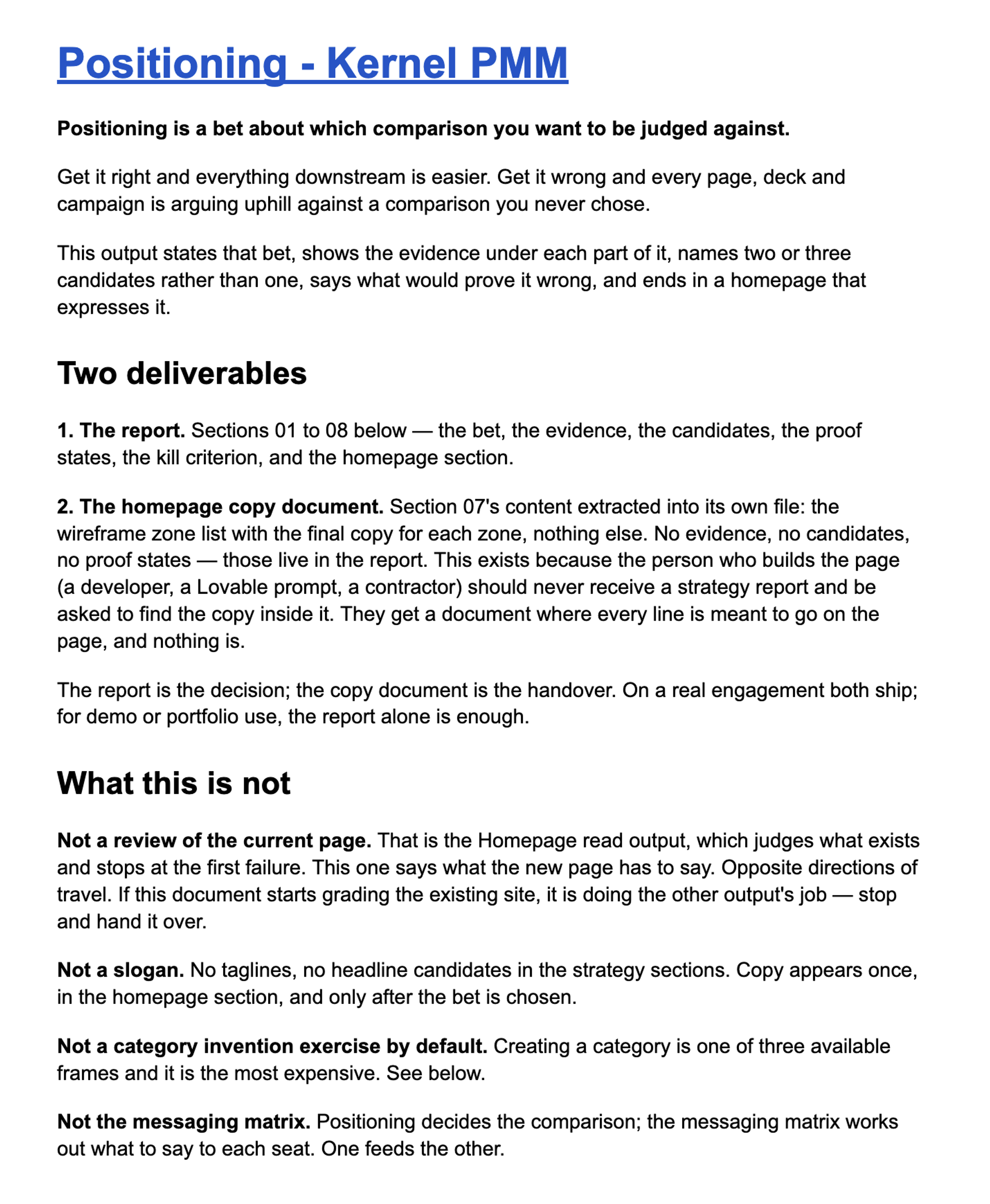
An excerpt of the instructions Kotthapalli gave Claude to create his positioning-statement skill
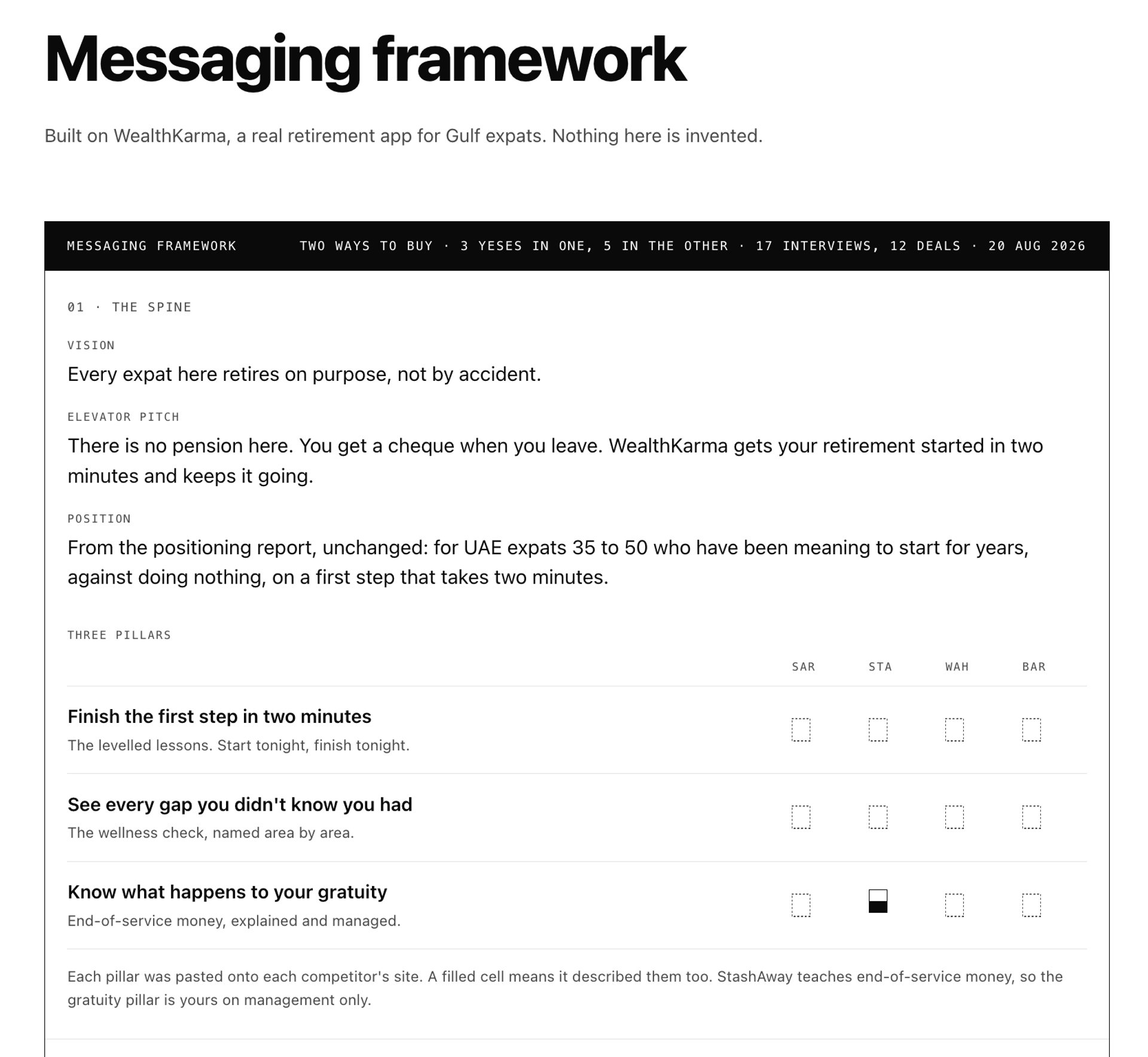
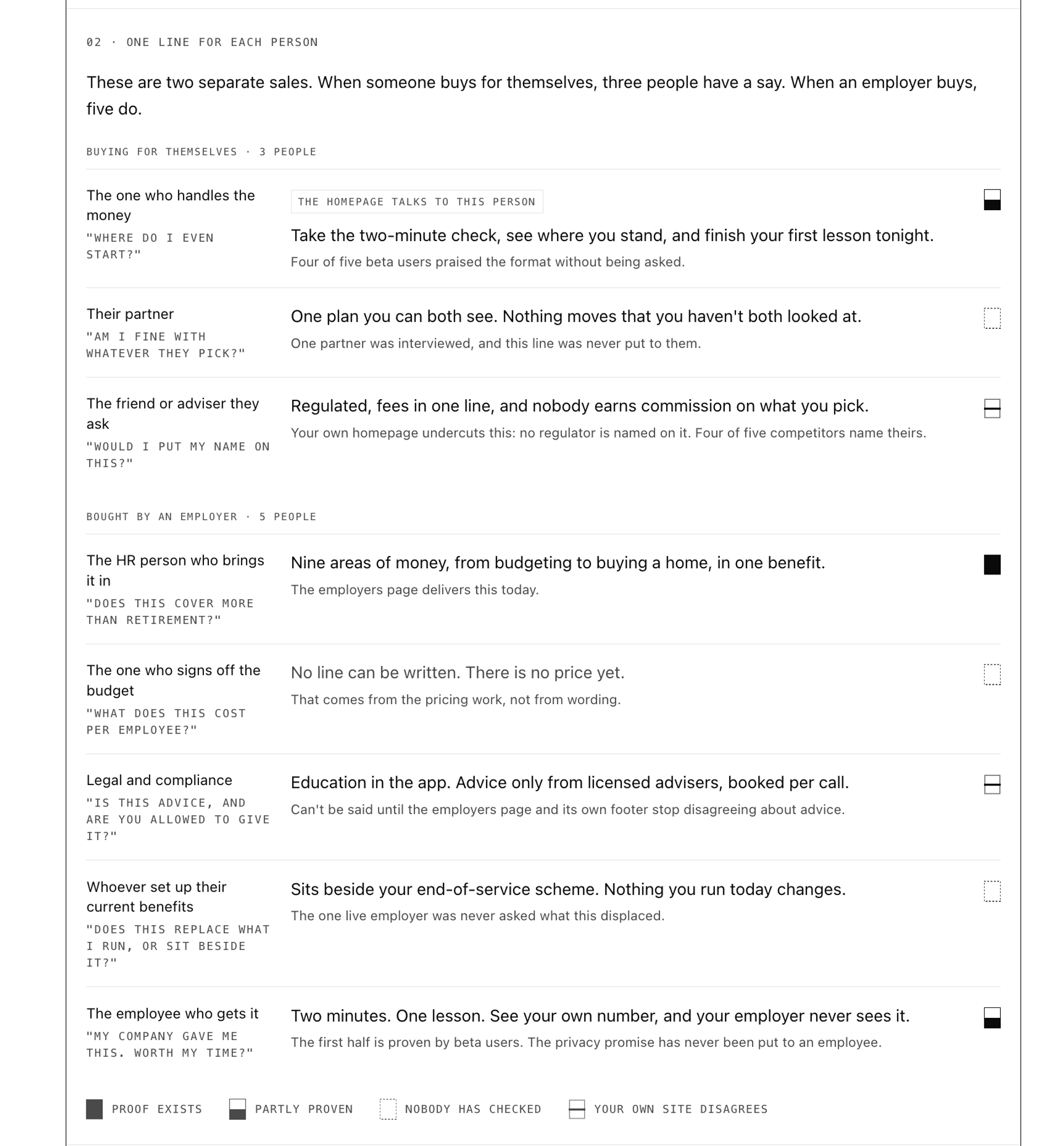
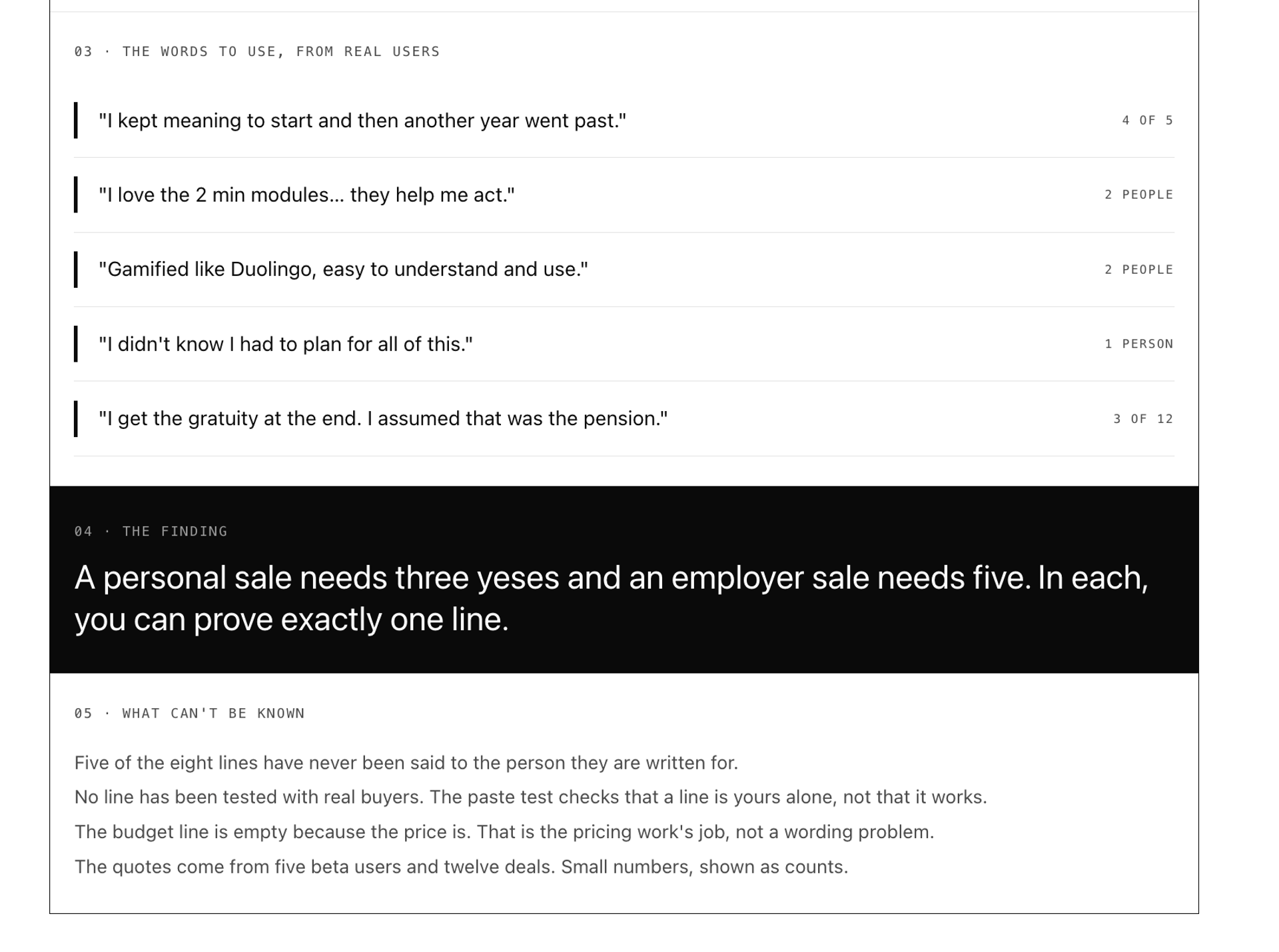
An excerpt from the GTM strategy Claude produced for Wealth Karma using Kotthapalli’s product marketing skills.
“With the skills, it’s much more detailed and segmented,” he says.
Step 2: Give the teammate the variables that change
With an established framework, Kotthapalli can swap in information that changes from campaign to campaign.
For segmented messaging, he gives Claude:
- The persona: Who is the customer?
- The segment: Which subset of that audience is he targeting?
- His messaging framework: What rules should the messaging follow?
- The channel: Is this for email, WhatsApp, a website, or another platform?
Claude then uses the same underlying methodology to create messaging for each combination.
“Before AI, this was done manually,” Kotthapalli says. “What I do now is make a persona and feed it to AI. I feed the segments. And I have a messaging framework that I made myself based on my experience.”
That setup lets him reuse the same thinking without rewriting the instructions every time a campaign targets a new audience.
While working on a past contract with B2B company FoodVessel, Kotthapalli used the system for customer messaging tied to its acquisition funnel. Around 15% of visitors converted into accounts, and about 3% of those accounts went on to place orders. Previously, those numbers were zero, as the organization had no capacity to incorporate customer messaging.
The system gave him a way to produce initial results rapidly and iterate at lightning speed, proving how valuable an AI-driven system could be for a new company or function.
Step 3: Pass the work from skill to skill
Kotthapalli’s product marketing teammate isn’t one giant agent that works invisibly in the background; rather, it’s a series of specialized skills.
“Research, analysis, positioning, messaging, publishing – everything is a skill,” he says.
After research produces an output, Kotthapalli moves it into the next stage. Competitive analysis informs positioning, which feeds messaging, which turns into assets such as emails, one-pagers, or pitch decks.
There’s still a human handoff between those stages.
“It’s not completely automatic,” he says.
That manual step is intentional. Kotthapalli wants AI doing the repeatable work, not making every marketing decision. Each handoff acts as a check point where he can review and improve the results before passing them to the next skill.
Keeping the human in the loop
Kotthapalli divides product marketing into six broad stages: (1) research, (2) competition, (3) segment, position and price, (4) message, (5) launch and enable, and (6) measure and maintain.
He says that while research, competition, message, and measure and maintain can run in AI once the right systems are in place, the remaining two stages need human input.
“You need to decide what segments you’re targeting with your product,” Kotthapalli says. “How you launch it, which markets you launch in, what price you’re launching at – there’s a lot of judgment involved.”
That’s why “teammate” is a useful way to think about the system. Kotthapalli hasn’t automated himself out of product marketing; rather, he’s outsourced the repeatable parts of his job to a system he built using his own methodology.
Build your first AI teammate around one thing you already do well
You don’t need to reproduce Kotthapalli’s entire product marketing setup to see similar benefits.
Follow this quick-start guide to adding an AI member to your team:
- Pick one process you repeat often and already understand well.
- Map its steps.
- Document the framework you use.
- Turn that framework into a reusable skill in your AI tool of choice.
- Test it on real work.
Kotthapalli says that “test” is the operative word.
“Don’t blindly trust AI,” Kotthapalli says. “You still need to test it out.”
If you take one thing away from this article, it should be that AI works best when you train it using your process, rather than giving it a broad job description.
Related
More data from the AI Lab.


